
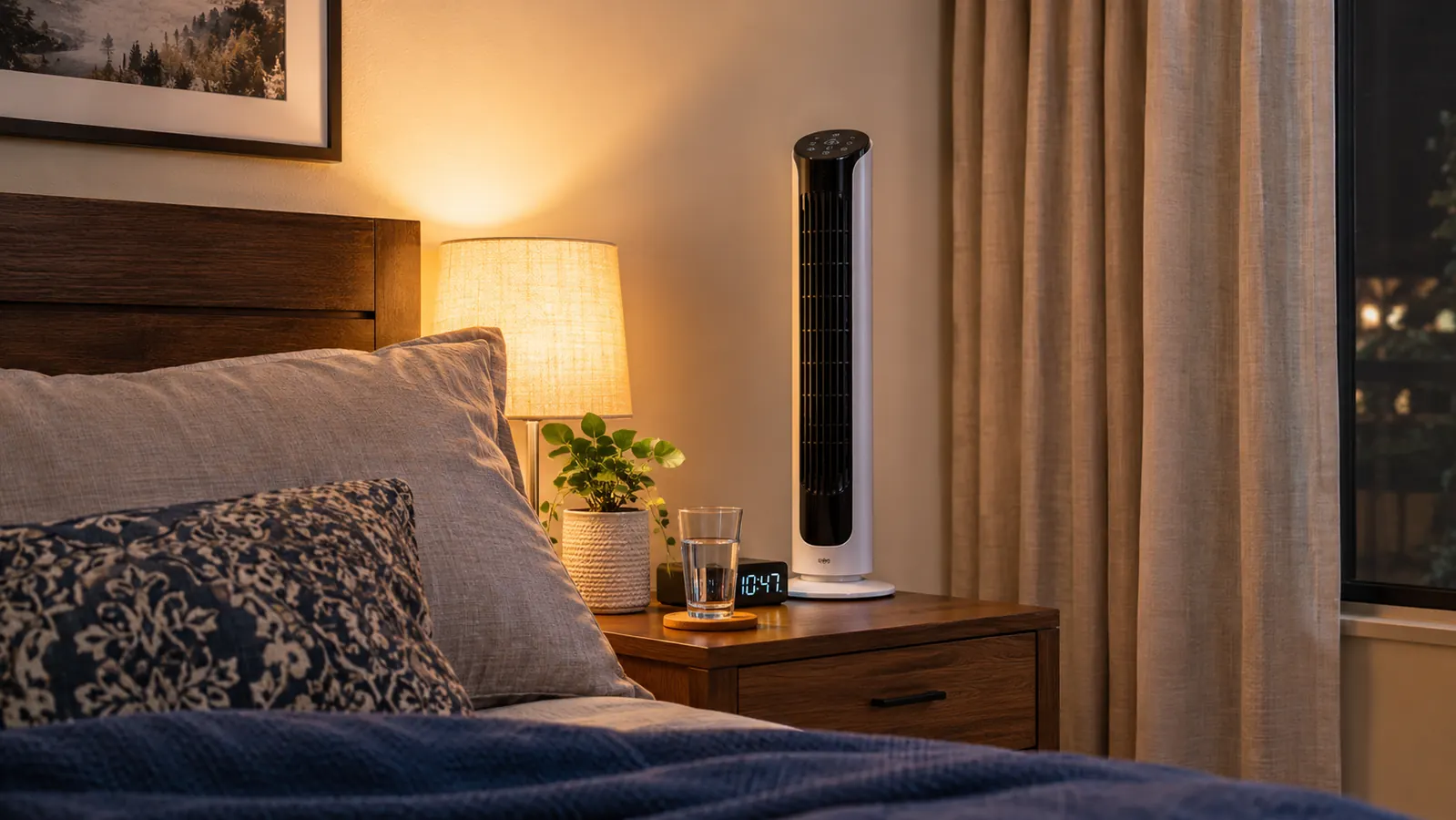
The fan I retired in July was a 20 inch box fan that had lived in our basement for a decade. It moved a wall of air and it sounded like a truck idling at a stoplight. Every time the window air conditioner cycled off, the box fan became the loudest thing in the room, and Greg would roll over and mumble something. So when I bought the Levoit Windi, I was not shopping for cooling. I was shopping for silence plus a breeze on my face at two in the morning.
Three months in, I have a fair amount to say, including two things the product page never quite tells you. One of them is genuinely useful. The other is the reason I nearly put it back in the box during the first week.
The Quick Verdict
Quiet enough to sleep beside and small enough for a nightstand, but it moves a narrow column of air, not a cool room. Buy it for your side of the bed, not for the whole bedroom.
Amazon Check Today's Price →The Fan I Run at 2 a.m. Without Waking My Husband
Thirteen inches tall, 3.4 pounds, five speeds, and a remote that stays on the nightstand so I never have to sit up during a flash.
Amazon Check Today's Price on Amazon →How I've Actually Been Using It
Our bedroom is upstairs and faces west, which means it holds the afternoon sun like a brick oven. By six in the evening the wall behind the bed is warm to the touch. In summer we run one window air conditioner and Greg keeps the thermostat at 70, and the room gets to merely warm, which is the best it ever gets. I am 55, I work day shift as a pharmacy technician, and I have been waking up sweaty since I was 50. The worst stretch was 52 to 54. It is better now, but most nights I still get at least one flash, and the flash is what wakes me.
The Windi sits on my nightstand, about two feet from my pillow, angled at my head and shoulders. It is 5 inches deep by 5 inches wide at the base and 13 inches tall, so it takes up less of the nightstand than my water glass and my phone combined. Before bed I set it to speed one or two and put the timer on. When a flash hits, I pick up the remote and bump it to three or four until the heat passes, then drop it back down.
That is the whole routine. I have not moved it since July, which tells you something, because I move everything. I have rearranged this bedroom four times in three years looking for a setup that works.
For context, this is the fifth thing I have tried for sleep heat. The pillowcases came first in March, then the cooling pad under the sheets in April, then the blanket in late May, then the pajamas in June. All of them help with the surface you are lying on. None of them move air, and moving air is what turns a sweaty three in the morning into an ordinary one. That gap is why the fan ended up mattering more than any of the bedding did.
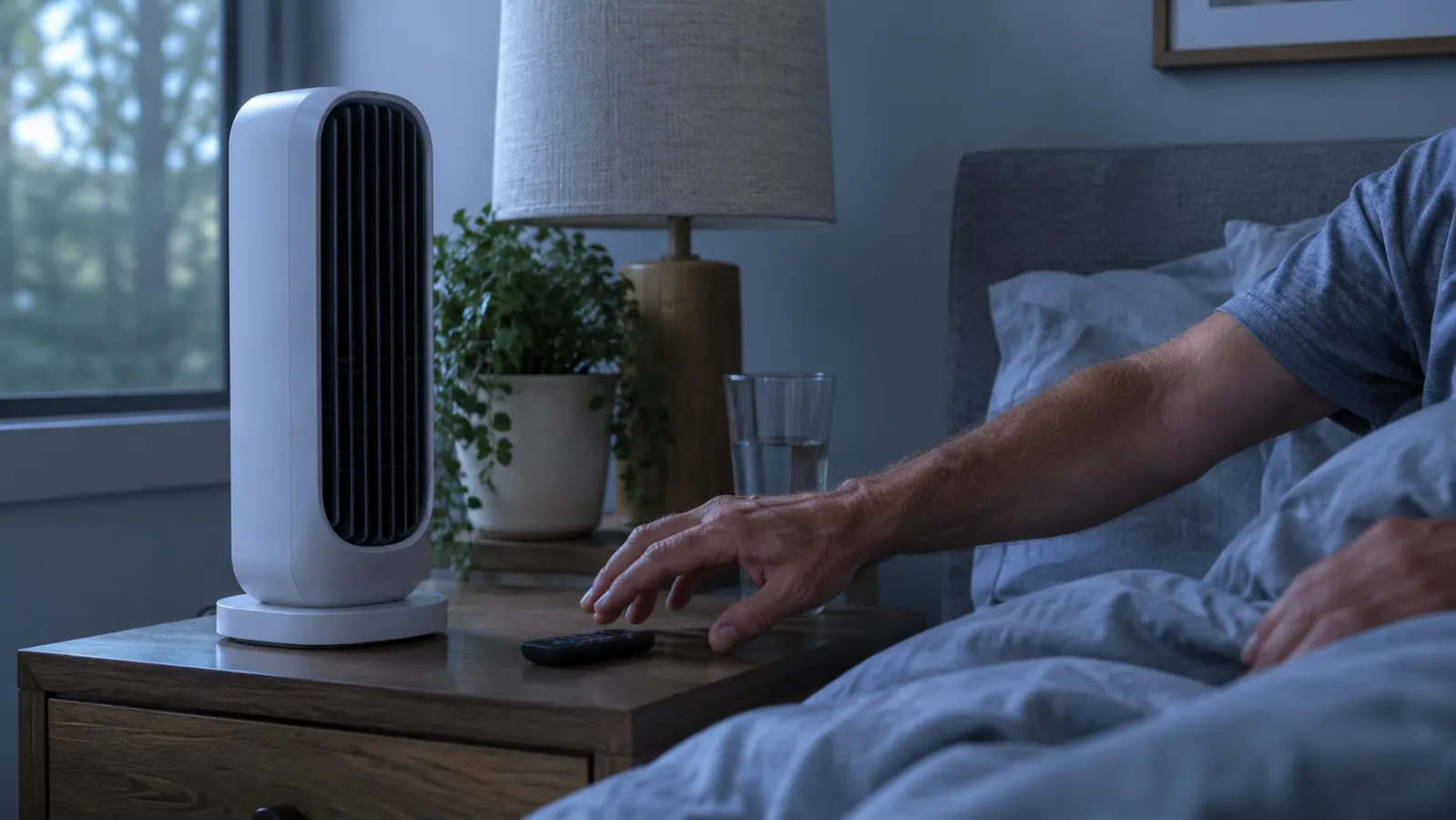
The 20 dB Claim, Tested in a Bedroom Instead of a Lab
Levoit advertises 20 dB and states it holds across all five speeds. I cannot measure decibels, so I will tell you what I actually hear. On speed one, standing a foot away, I hear almost nothing. From my pillow with the fan pointed at me, it is a soft hush, quieter than the window unit and quieter than Greg's breathing. On speed five, from the same distance, I hear it clearly. Not a jet engine. Not 20 dB in any room I have ever slept in, either.
Here is the honest part that nobody puts in a listing. Fan noise ratings are taken in a treated space, at a set distance, with nothing else running. Your bedroom has a window unit, a house that settles, a floor that creaks, and a husband. If you buy this expecting a number, you will be disappointed. If you buy it expecting the quietest setting to be effectively silent and the top setting to be a soft whir you can sleep through, you will be pleased, because that is what it does.
The reason it can be quiet at all is the DC motor. It draws a maximum of 7.5 watts and runs on standard 120 volt household current, which is a large part of why I stopped feeling guilty about leaving it on all night. My old box fan made me feel like I was running a small appliance from 1974.
One more thing about the sound. It is a moving-air sound, not a motor sound. There is no rattle and no hum at the low speeds, so it does not compete with the window unit. If you need loud white noise to fall asleep, this is the wrong purchase. It is too quiet to do that job at the settings you would actually use.
What 13 Inches of Tower Actually Does for Airflow
This is the part I got wrong when I ordered, and it is the part that nearly sent it back. A 13 inch bladeless tower moves a column of air, and the column is narrow. It is not a box fan pushing a wall across the room. Pointed at my pillow from two feet away, it is exactly right. Pointed at the foot of the bed from across the room, it is a rumour.
In the first week I had it on the dresser, six feet from the bed, on speed three, and I could barely feel it. I assumed the fan was weak and started reading return policy. It is not weak. It is directional. Once I moved it to the nightstand and aimed it at my own face, speed one was enough to fall asleep and speed three was enough to get through a flash. The fan did not change. The distance did.
So the short version is this: it is a personal fan, not a room fan. Levoit lists it for bedrooms, dining rooms, home offices, kitchens and kids rooms, and I would read that as bedrooms with a nightstand, offices with a desk, kitchens with a counter. Anywhere you are sitting still within arm's reach of it. Anywhere you expect it to reach across a room, it will disappoint you.
There is one real upside to the narrow column. Because it covers only my side of the bed, Greg does not get a draft on his neck, he does not complain, and I do not have to negotiate. For the first time in years I can run moving air all night and nobody argues about it. That alone changed how the bedroom works for us.
It does not cool the bedroom. It puts moving air on my face and chest at two in the morning on my side of the bed only, and Greg never feels a thing. That turned out to be the entire job.
The Nightstand Fit Nobody Mentions Before You Buy
The footprint is 5 by 5 inches. On a normal nightstand that is fine. On a small nightstand with a lamp, a clock, a phone, a book and a glass of water, it is one more thing, and you will need to move something. I moved the lamp.
Height matters more than people think, and this is the measurement I would want before ordering. At 13 inches tall sitting on a nightstand, the air outlet lands roughly level with my shoulder when I am propped up, which is exactly where I want it during a flash. If your nightstand is low and your mattress is high, you will be aiming at the side of the mattress rather than at yourself, and the effect drops off fast. Height is the difference between a fan that helps and a fan you forget is running.
It weighs 3.4 pounds and has a carrying handle, so moving it down to the kitchen counter in the afternoon is not a chore. I do that on hot days while I am doing dishes. It is also light enough that I have knocked it over once on the way to the bathroom at 3 a.m. It survived without a scratch and without a wobble afterward.
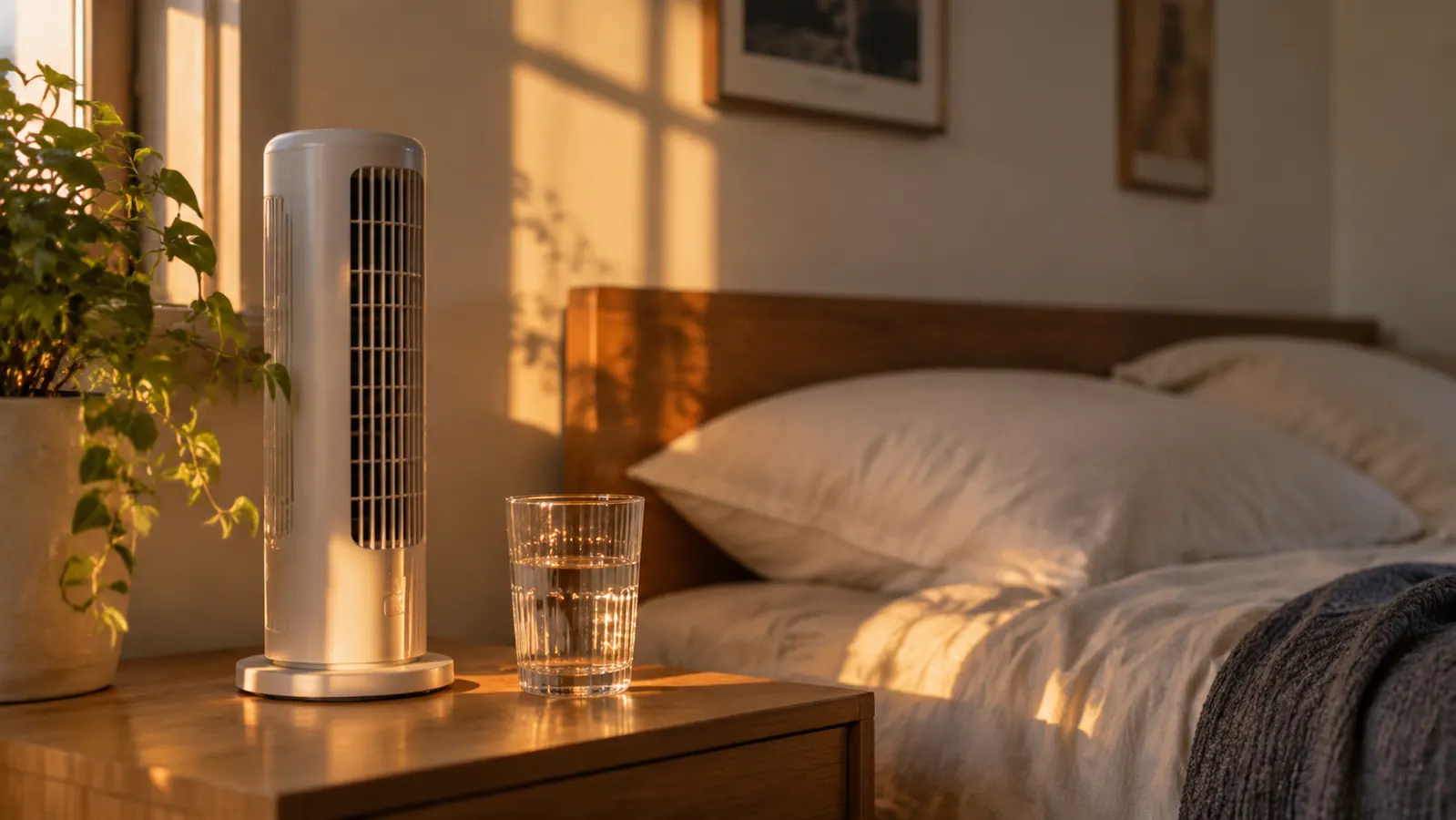
The Remote, the Timer, and What It Doesn't Do
The remote is the reason this fan works for me and the reason I nearly lost it twice. It is small. Mine lives on the nightstand beside the water glass. During a flash I do not want to sit up, find a button on the back of a fan in the dark, and cycle through five speeds while sweat runs down my neck. I want to press one button. That is what the remote is for, and it earns its place.
The timer is the other piece I use every night. I set the fan on low with the timer when I get into bed. It runs while I fall asleep and shuts itself off. Before this, I would leave the box fan going until morning and wake up with a dry throat and a stiff neck. The timer fixed a problem I had stopped noticing I had.
What it does not do: there is no app and no smart-home connection on this model, and I did not want one. I have enough devices that want an account and a password. At three in the morning, one button on a small remote is the most technology I can manage, and I suspect I am not alone in that.
The bladeless design has a second small benefit. There are no exposed blades to collect dust the way my old fan did, so it does not need the same tear-down and wash every few weeks. A wipe now and then has kept it looking new since July.
Where It Genuinely Falls Short
The first shortfall is the obvious one. It does not cool the air. No fan does. It moves air across your skin, which speeds up how quickly heat leaves you, which is why it feels cooler. When my bedroom is 84 degrees and humid, this fan makes 84 degrees more bearable. It does not make it 78. If you are expecting the room itself to feel different when you walk in, it will not.
The second is range. If your bed is tall, or wide, or you sleep on the far side of a king, you will need the fan close and probably on a higher speed. A 13 inch tower on speed one will not carry eight feet. Plan on nightstand distance, or plan on being disappointed.
The third is noise at the top end. Speeds one and two are close to silent. Speed five is audible from the pillow. That is a fair trade for me, since I only use speed five for ten or fifteen minutes during a flash, but if you want a fan that stays at maximum all night and disappears into the background, this is not that fan. Quiet and powerful are opposing goals, and Levoit clearly leaned toward quiet.
The fourth is the remote itself. It is small, it lives on a nightstand crowded with other things, and I have had to fish it out from behind the bed frame twice. A small hook on the side of the nightstand would solve it. I have not gotten around to buying one, which is probably the most honest thing I can tell you about how minor that complaint is.
And the fifth is the frame around all of this. This fan makes the heat easier to sleep through. It does not reduce hot flashes and it does not fix anything hormonal. I talked to my doctor about the flashes years ago and I am not going to pretend a small appliance belongs in that conversation. It is comfort, not treatment.
What I Liked
- Speed one is close to silent, quiet enough to sleep next to on a shared bed
- Five speeds let you go from a whisper to a real breeze during a flash
- 3.4 pounds with a carrying handle, easy to move between bedroom and kitchen
- 5 by 5 inch footprint fits a nightstand without taking the whole surface
- Remote and timer mean no getting out of bed at three in the morning
- Draws a maximum of 7.5 watts, so it can run all night without guilt
- Bladeless design means no exposed blades to collect dust
Where It Falls Short
- Does not cool the room, only moves air across your skin
- Narrow column of air, so it has to sit close to you to matter
- Speed five is clearly audible from the pillow
- Remote is small and easy to misplace in the dark
- Still a personal fan rather than a room fan, even on oscillation
- No app or smart-home connection, which some people will want
Who This Is For
This is for the woman who wakes up hot at two in the morning and does not want to wake the person next to her. It is for a bedroom with a nightstand within a couple of feet of the pillow, a west-facing window in July, and one window air conditioner that cools the room to merely warm. It is for someone who wants air on her face and chest, on her side of the bed, at a volume that does not register over a sleeping husband.
It is also, honestly, for someone who has already tried the bedding. The pillowcases, the cooling pad, the blanket, the pajamas: they take the heat off what you are lying on. They do not move the air. Those are different jobs, and the fan is the one I reach for during an actual flash at three in the morning when the sheets have gone damp under my back.
Who Should Skip It
Skip it if you want the whole bedroom to feel cooler. Skip it if your bed is far from any surface you can set a fan on, because the airflow will not cross the gap. Skip it if you need white noise to fall asleep, since the settings you would actually use are too quiet to do that job. Skip it if you want a fan running at maximum all night, because that setting is audible and you will hear it.
And skip it if you are hoping it will stop the flashes themselves. It will not. Nothing I have bought for this bedroom does. The fan makes the heat easier to sleep through, which is a smaller promise and a different one, but it is the honest one, and after three summers of broken sleep I will take an honest small thing over a big false one.
If Your Side of the Bed Is the Hot Side, Start Here
I bought the Levoit Windi in July for the nightstand and have not moved it since. Five speeds, a timer, a remote, and a low setting quiet enough that Greg never stirs.
Amazon Check Today's Price on Amazon →