
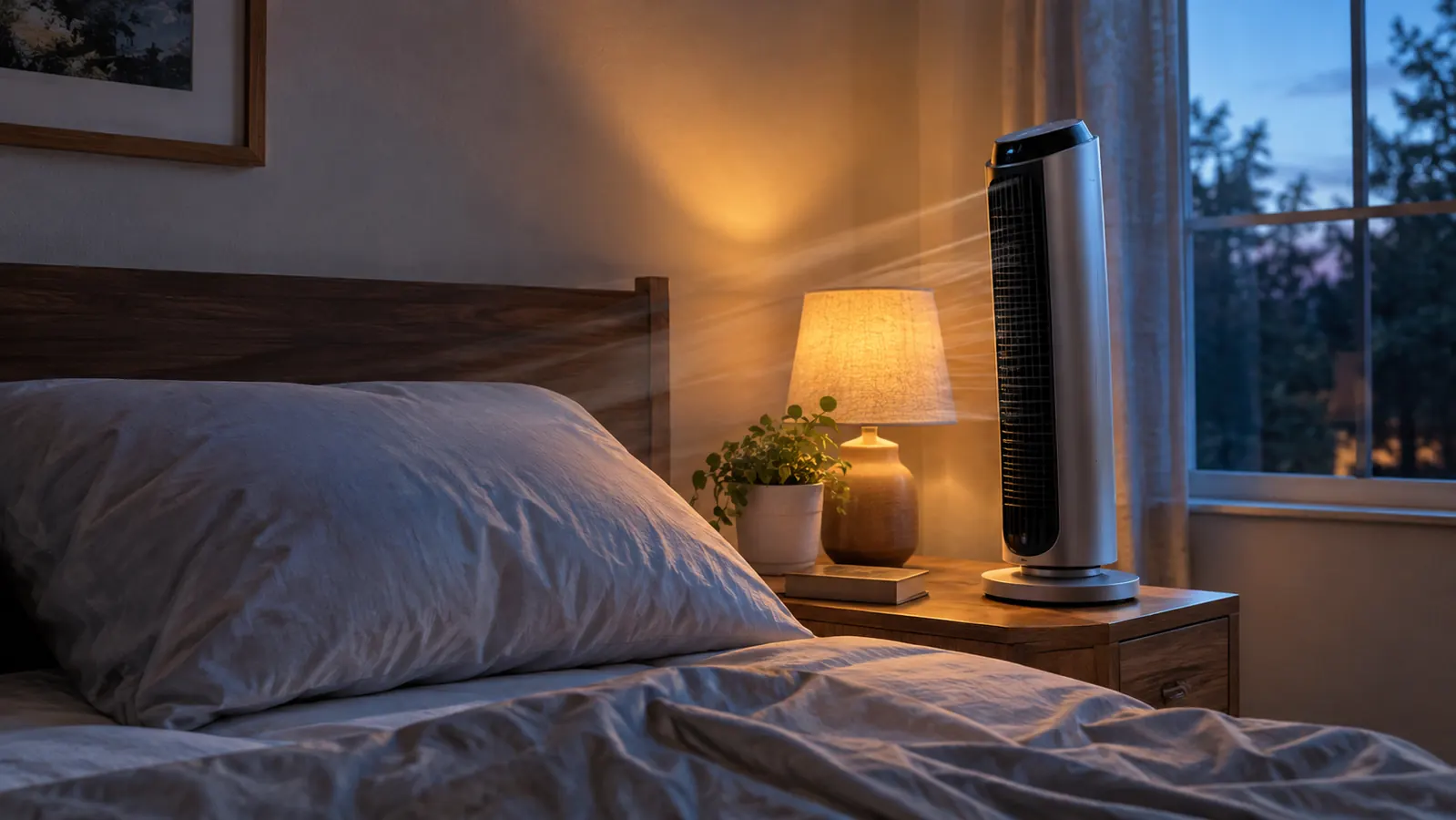
At 2:40 on a July morning I woke up with the pillow damp under my cheek and my hair stuck to the back of my neck, and the first thing I did was reach sideways in the dark for a remote control. Not my phone. The fan. I have been waking up like that on and off since I was fifty, and the thing that gets me back to sleep is not a bigger air conditioner. It is moving air, right across my face, from something small enough to sit on the nightstand without taking the whole thing over.
That something is the Levoit Windi, a mini tower fan I bought in July and have run almost every night since. It is thirteen inches tall, five inches square at the base, and it weighs about as much as a hardcover book. It sits on my nightstand, aimed at my pillow, and it moves air across my side of the bed. That last part matters more than I expected it to. Greg sleeps a foot away from me and has never once complained about a draft, because the air never gets to him.
The Quick Verdict
A genuinely quiet little tower fan that cools one person's pillow instead of the room. Worth it if your problem is still air at 2 a.m., not a hot bedroom.
Amazon Check Today's Price →The Fan That Points At You, Not The Room
Thirteen inches tall, five inches square, five speeds, a timer, and a remote you can find in the dark without opening your eyes. It fits on a nightstand next to the water glass.
Amazon Check Today's Price on Amazon →How I've Used It
Our bedroom is upstairs and faces west, so it holds the afternoon sun like a brick oven and then slowly gives it back all evening. We have one window air conditioner and a thermostat Greg keeps at 70. By ten o'clock the room is cool enough on paper. What it is not is moving. The air sits there, and still air is what wakes me, because it lets the heat from my own body pool around me until I am lying in a warm spot I made myself.
Five inches square turned out to be the number that mattered. My nightstand is not big. It holds a lamp, an alarm clock, a water glass, and whatever paperback I am pretending I will read, and there was still room. The Levoit is thirteen inches tall, so it sits below the lampshade and does not block the clock. I have had bigger fans on that table and moved them to the floor within a week because I could not see what time it was.
So the fan goes on the nightstand, pointed at the pillow, set to the second of the five speeds. I set the timer and let it run until I am asleep. The first week I ran it all night, but I found I did not need that, and the timer means one less thing to think about at midnight. When I wake at three with my sleep shirt stuck to my back, I pick up the remote, bump it to a higher speed, and lie back down. Ten minutes later I am usually out again.
One thing I had to learn: it has to be aimed. This is not a machine that fills a room. Point it at the ceiling and you will not feel it. Point it at your pillow and it is exactly enough. If you roll over and knock the nightstand, you will spend the next four minutes finding the sweet spot again. That is the trade for the narrow airflow, and I will take it, because the narrow airflow is the reason Greg can sleep in the same bed.
What 20 dB Actually Sounds Like at 2 A.M.
The listing says 20 decibels across all the speed levels, and I did not believe that before I bought it. Twenty decibels is quieter than a whisper. What I can tell you is that on the first two speeds I genuinely cannot hear the fan over Greg's breathing, and Greg breathes like a man who has never worried about anything in his life. I have lain there in the dark trying to decide whether it was running and had to put my hand in front of it to check.
The higher speeds are a different story. On four and five there is real airflow noise, a soft whoosh rather than a rattle, and I can hear it. It does not bother me, because I am only on those speeds when I am already uncomfortable and would rather have the air than the silence. But if you need a bedroom to be absolutely silent, do not buy this, run it on high, and then act surprised.
What I was not prepared for was the absence of the click and rattle my old fan had. That fan is the reason I stopped using a fan at night for two years. This one is a bladeless tower with a DC motor, and the listing says it draws at most 7.5 watts, which is the reason I do not think twice about leaving it running while I read. Nothing about it sounds like a motor working hard. It sounds like air.
Five Speeds and the Two I Actually Use
Five speeds is more than I need, and I say that as someone who uses exactly two of them. Speed one is for going to sleep on a mild night. Speed two is the default from June through September. Speed three exists, I have used it, and it is fine. Speeds four and five are for the ten minutes after a flash, when I want to feel like I am standing in front of an open window in October, and for folding laundry in the upstairs hallway.
The fan oscillates and I turned that off in the first week. Oscillation is a nice feature for a living room, where you want the air to sweep across a couch. For sleeping I want it aimed, steady, and pointed at one specific square foot of pillow. It is good to know the option is there. It has been set in one position since July.
The handle on top is small but it does the job, and at 3.4 pounds I move this fan around more than I expected to. It lives on the nightstand at night, and during the day it comes into the bathroom while I dry my hair, or out to the kitchen counter while I am dealing with something on the stove. It is a tabletop fan, so it does not go on the floor and it does not go on the porch. Within arm's reach, it is genuinely useful.
The Timer and the Remote, Which Turned Out to Matter Most
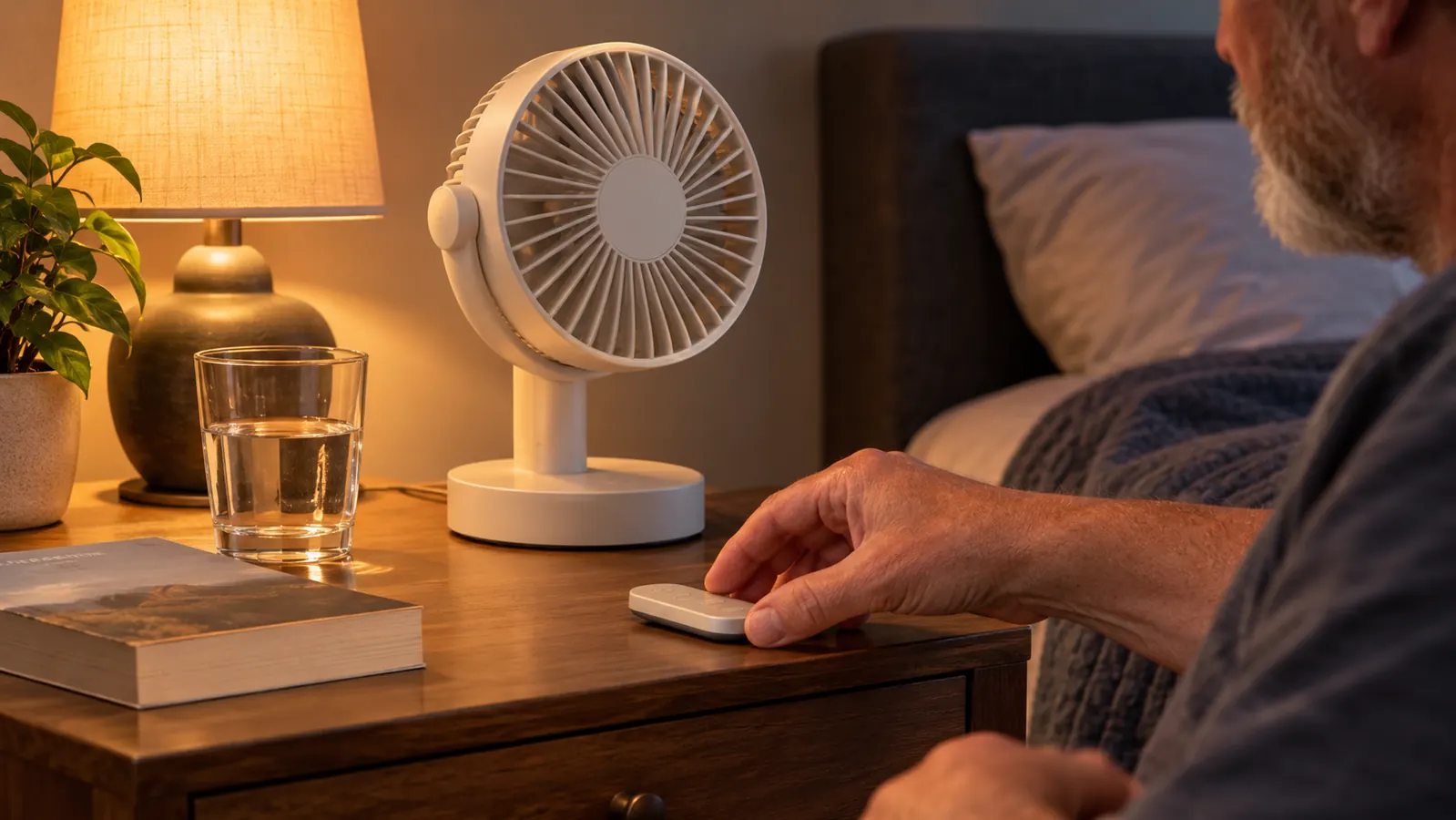
I bought this for the noise, and what I would buy again is the remote. The Levoit remote lives on the nightstand between my water glass and the clock, and I can find the right button without opening my eyes. Before this fan, adjusting the airflow meant getting out of bed, walking around to the other side, and crouching. At 2 a.m. with a damp sleep shirt, that walk is the difference between going back to sleep and being awake for an hour.
The remote is small and I have dropped it behind the nightstand twice. Both times I found it with my hand without turning on a light, which tells you something about how often I use it. It does not light up and it does not need to. There are only a handful of buttons, and after a week my thumb knew where they were without any help from me.
The timer is the other half of it. I set it when I get into bed, and it stops on its own once I am under. I do not want air moving across my face for eight hours. I want it for the twenty minutes it takes me to stop thinking. If I wake up later and want it back, the remote is there. That back and forth happens most nights in the summer and takes about two seconds in each direction.
There is nothing smart about this fan. It does not connect to anything, it does not learn my schedule, and it has never once sent me a notification. It has five speeds, a timer, and an oscillation setting, and the remote handles all of it. I have come to think of that as a feature. The last appliance in this house that wanted to talk to my phone is currently unplugged in the basement.

What It Does Not Do
It does not cool the room. Levoit calls it a fan for the bedroom, and that is exactly the size of the claim, so hold them to it. If your bedroom is eighty-five degrees at bedtime, this will move eighty-five degree air across your face and you will still be hot. It does not replace our window air conditioner and I would not ask it to. What it does is take a room that is already cool enough and make it feel like there is a breeze in it, which is a different problem entirely.
It does not stop a hot flash. Nothing I own stops a hot flash, and if a product page tells you otherwise, close the tab. What this fan does is shorten the miserable part. The flash happens, I am awake and sweating, and instead of lying there waiting for my body to sort itself out, I have moving air on my skin and something to do with my hands. That is comfort, not treatment. Anything past comfort is a conversation for your doctor.
And it does not cool Greg, which is the entire point. He runs warm in his sleep, he likes his own heavy comforter, and he has zero interest in a breeze. The airflow on this fan is narrow enough that it lands on my pillow and nowhere else. If you want the whole room to feel cooler, you need a different machine. If you want your side of the bed to feel cooler without starting an argument about the thermostat, this is the shape of the solution.
What I Liked
- Quiet enough on the first two speeds that I forget it is running and have to check with my hand
- The remote turns a 3 a.m. adjustment into a two-second reach instead of a walk around the bed
- Narrow airflow, so the person sleeping next to you is not sitting in a draft all night
- 3.4 pounds with a handle on top, easy to carry to the bathroom or the kitchen counter during the day
- The timer stops it after I am asleep without me getting up to do it myself
- Thirteen inches tall and five inches square, so it fits a crowded nightstand and does not block the clock
Where It Falls Short
- It cools one person, not a room. On an actually hot night it is comfort, not a fix
- It has to be aimed. Nudge the nightstand and you lose the airflow until you re-aim it
- The top two speeds are audible, which surprised me after how quiet the low ones are
- It is small by design. If you want to feel air from across the bedroom, this will disappoint you
- The oscillation setting is there but I never use it, so I paid for a feature I ignore
The air reaches my pillow and stops before it reaches Greg. A foot of bed between us, and in nine weeks he has never felt a thing.
Who This Is For
This is for the woman who has already done the obvious things. The window unit is in. The thermostat is where it is going to be. The bedding has been swapped for something that does not hold heat. And she is still waking at two in the morning because the air in that room has gone still. This fan fixes that specific thing. It is also for anyone sharing a bed with a person who does not want a draft, which is most of us.
It is a good fit for a small bedroom, a home office, or a kitchen counter where you are standing over a stove in August. It is a good fit for a nightstand with about a square foot of free space. It is a good fit if the sound of moving air helps you fall asleep, as long as you stay on the low speeds. And it is a good fit if you want to reach over at 3 a.m. and change something without getting up.
Who Should Skip It
Skip it if your bedroom is actually hot. This is a comfort device for a room that is already cool, and if you are expecting it to lower the temperature you will be disappointed and annoyed, probably in that order. Skip it if you want to feel air from across the room, because the reach is short by design. And skip it if you need the fan on the floor. It is a tabletop fan, thirteen inches tall, and it wants to be at the height of the person it is cooling.
Skip it, too, if you want a fan that doubles as white noise. The low speeds are close to silent, which is wonderful for sleeping next to someone and not much use if you need a wall of sound to drown out a snoring husband. And if you are looking for something to cool the whole upstairs, this is not that. It is one small fan doing one small job in one small space, and doing it well.
Move The Air At Your Pillow, Not The Whole Room
Five speeds, a timer, and a remote on the nightstand. Thirteen inches tall, 3.4 pounds, and quiet enough on the low settings that you will put a hand in front of it to check.
Amazon Check Today's Price on Amazon →