
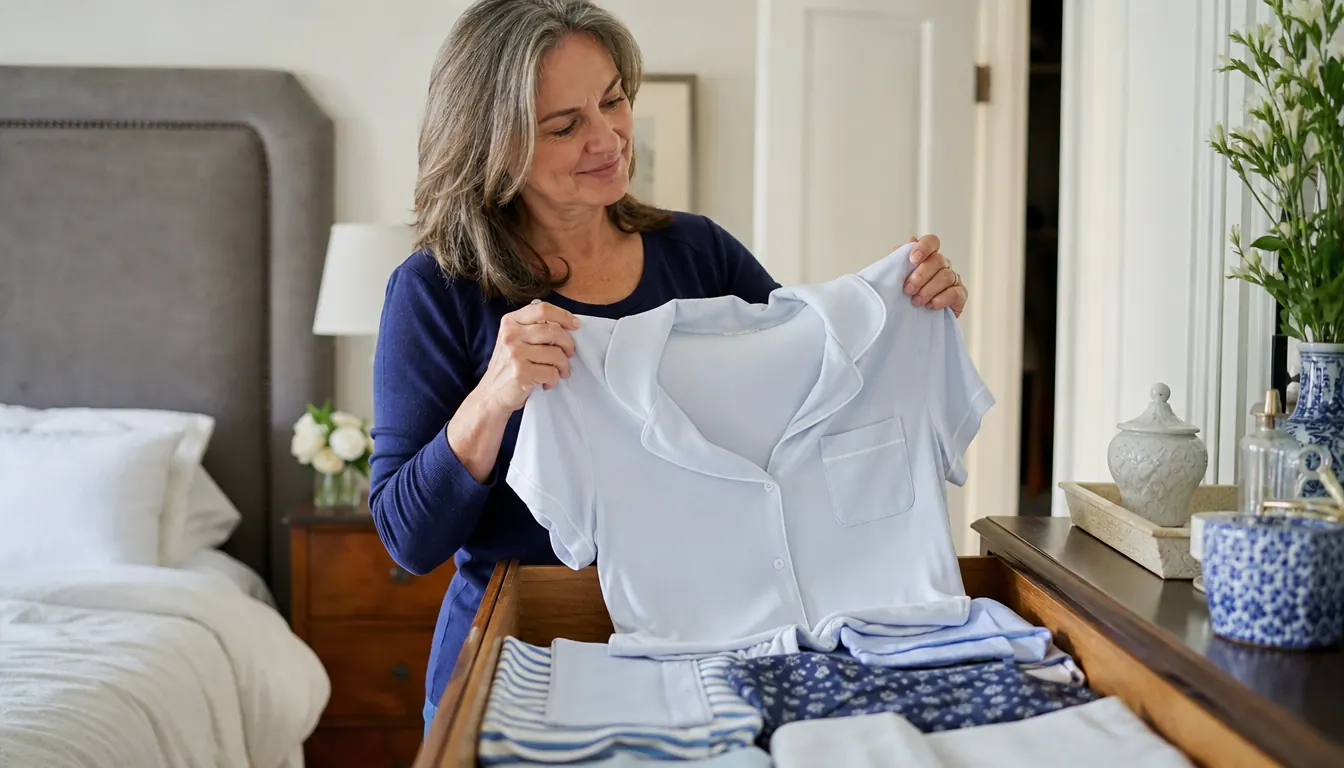
It is 3:12 in the morning and I am standing in front of my closet again, peeling off a damp sleep shirt and hunting for something dry. That was my life from about 52 to 54. Two, three, sometimes four times a night. I would wake with the back of my neck wet and the sheet stuck to my legs, and by the time I had changed and remade the bed I was wide awake until the alarm went off. I am 55 now. I work day shift as a pharmacy technician at a hospital in Kenosha, Wisconsin, and I need my sleep more than I need almost anything else.
So I did what I do with everything. I tested things in my own bedroom and kept notes. Pillowcases first, then a mattress pad, then a blanket. Pajamas were the piece I got wrong twice before I got right, and the set I finally landed on is the NACHILA bamboo viscose tank top and capri set. What follows is the order I would walk a friend through if she texted me tonight asking what to buy.
The Set That Is Dry Again Before You Are
Bamboo viscose, tank top and capri pants, made for a warm bedroom. Two sets is the whole system.
Amazon Check Today's Price on Amazon →Step 1: Start With the Fabric, Not the Label
Every set on the shelf says cooling now. Most of them mean it the way a car is advertised as sporty. The word on the front tells you almost nothing. The fiber tells you most of it. What you want is a fabric that moves moisture off your skin and then lets it go, so it is dry again in a few minutes instead of sitting against your back like a wet washcloth.
Bamboo viscose is what worked for me. It feels cool when you first put it on, it is light in the hand, and after a sweat it comes out damp rather than soaked. My old cotton nightgown was the opposite. Cotton is comfortable right up until it gets wet, and then it holds the wet against you. I would wake up clammy in cotton, throw the covers off, then get cold, then pull them back on. That loop is worse than the flash that started it.
I got this wrong twice before I got it right. The first set I bought, in the spring before the worst stretch, was a so-called cooling set from a big-box store. It had a mesh panel across the back and a hangtag that promised breathability. It was mostly polyester. The mesh panel sat right where I sweat the most, and by 2 a.m. it was a warm wet patch I could feel through the sheet. The second set was a silky satin thing I bought for a family wedding, and I tried sleeping in it once. It slid around all night, it held heat like a plastic bag, and I gave up on it by the second night.
So read the tag. Some stretch is fine. A heavy polyester blend is not, because polyester traps heat against the body. If the label is mostly polyester with a cooling sticker on the front, put it back on the rack.
One more thing on fabric, and it is the thing nobody mentions: weight. A thin fabric sleeps cooler than a thick one even when both are the same fiber. Hold the set up to a window. If you can see light through it, it will sleep cool.
Step 2: Pick a Cut That Lets Heat Leave
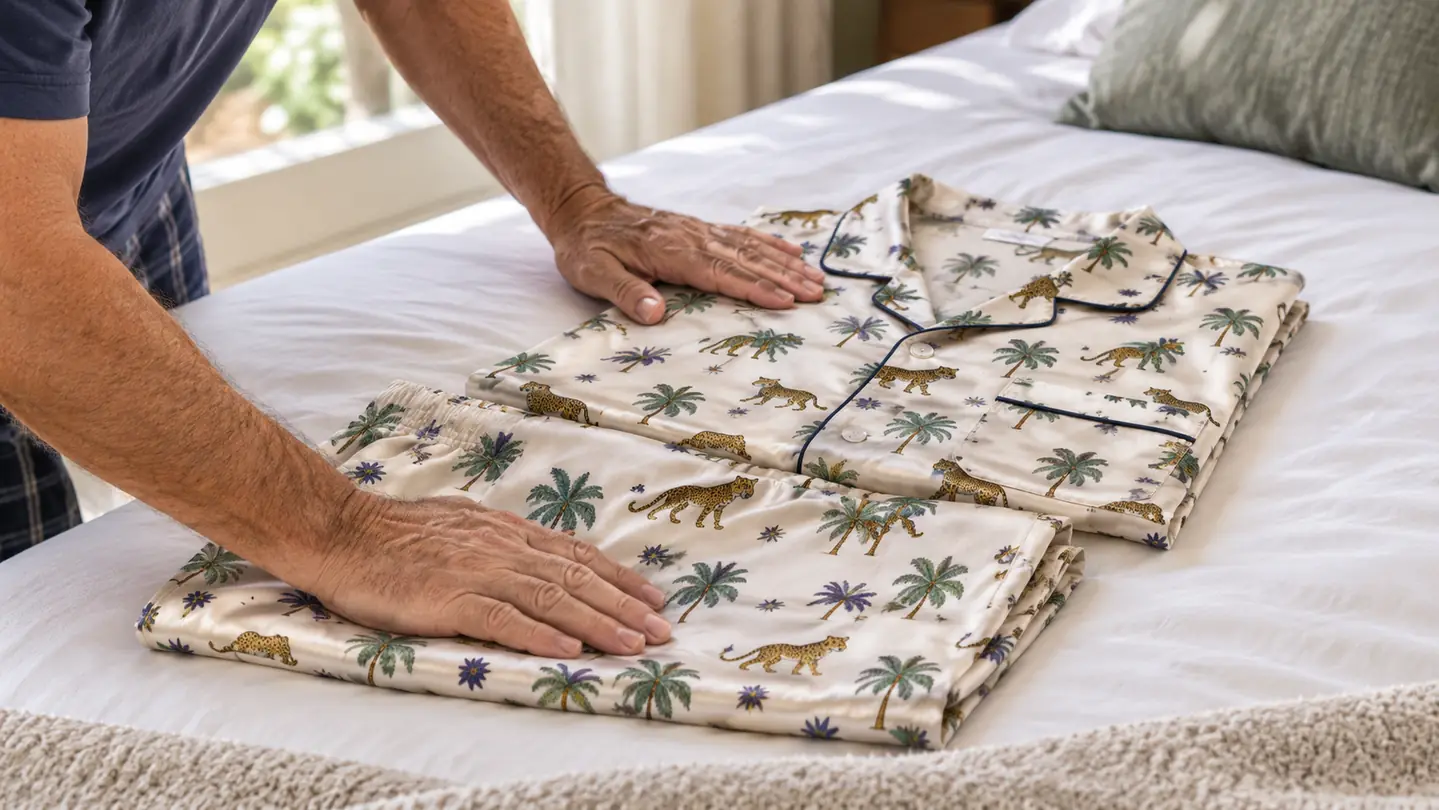
Heat leaves your body from your trunk and your limbs. Whatever covers more of you has more fabric to trap it. That is the plain argument for a tank top and capri pants over a long-sleeve set with full-length legs, and it is why I sleep in the short set even in January with the forced-air heat running.
Here is what that looks like in a Wisconsin February. The furnace is running, the thermostat is at 70 because Greg sets it, and the bedroom is upstairs where the warm air collects. In long pajamas I would wake at 1:40 with the backs of my knees wet and my chest hot under the top. In the short set, on a comparable night, I wake up warm and go back to sleep. The room did not change. What changed is how much of me was wrapped in cloth.
Capri length matters more than I expected. Full-length pants bunch behind my knees and hold heat there, and I would wake up with the backs of my knees sweaty. Capri pants stop below the knee, so there is bare skin at the ankle and air moving where I need it. On a cooler night I put a light blanket over my legs and leave the tank top alone. That is easier to manage than a whole set of long pajamas.
The NACHILA set is cut this way, tank on top and capri on the bottom, which is the combination I would pick again. If you cannot sleep without sleeves, size the top so it does not cling under your arms, because that is the first place fabric starts to feel hot.
Step 3: Get the Fit Right, Loose but Not a Tent
There is a narrow window on fit. Too snug and the fabric is pressed flat against your skin everywhere, which is where sweat collects. Too loose and it bunches under your back and you wake up lying on a wad of cloth. You want it to hang off you with a bit of air in it and still stay put when you roll over.
I wear a medium. Mine is a regular fit with a mid rise on the pants, so the waistband sits at my natural waist instead of digging in when I am on my side. That sounds like a small thing until you have spent a night with a waistband cutting into you at 2 a.m. Order your usual size, and if you are between sizes, size up. Loose is cooler.
A few fit checks that took me one bad night to learn. Raise both arms over your head while you are lying down. If the top rides up past your ribs or pulls tight across the chest, it is too small. Roll onto your side and press your hip into the mattress. If the waistband digs in, the rise is wrong for you, and no amount of washing will fix it. Then sit up and lean forward. A top that gapes open at the neck is not an issue in a crew neck, which is one reason this one suits me.
Wear it for one night before you decide anything. Fabric softens after the first wash, and a set that feels slightly roomy out of the bag is usually the right one. If it feels tight across the shoulders when you lie on your side, it is too small, and you will feel every seam by the time the clock turns over.
Check the return policy before you wash anything. You want the option to send it back if the fit is wrong, and most sellers will not take a set that has been through the machine.
Step 4: Plan for the 3 A.M. Change
No pajama will get you through every night dry. I still have bad nights. What changed is the frequency. Instead of changing my sleep shirt most nights, I change once or twice a week now, and the change takes about two minutes.
The first night I wore the new set was in June, the week the two sets arrived. I woke at 2:40 the way I usually did, and the top was damp at the back of the neck but not soaked through. I got up, swapped it for the second set from the top drawer, dropped the damp one in the basket, and I was back under the covers in under two minutes. The old cotton nightgown would have had me standing in front of the closet with the light on for ten minutes, wide awake and cross about it.
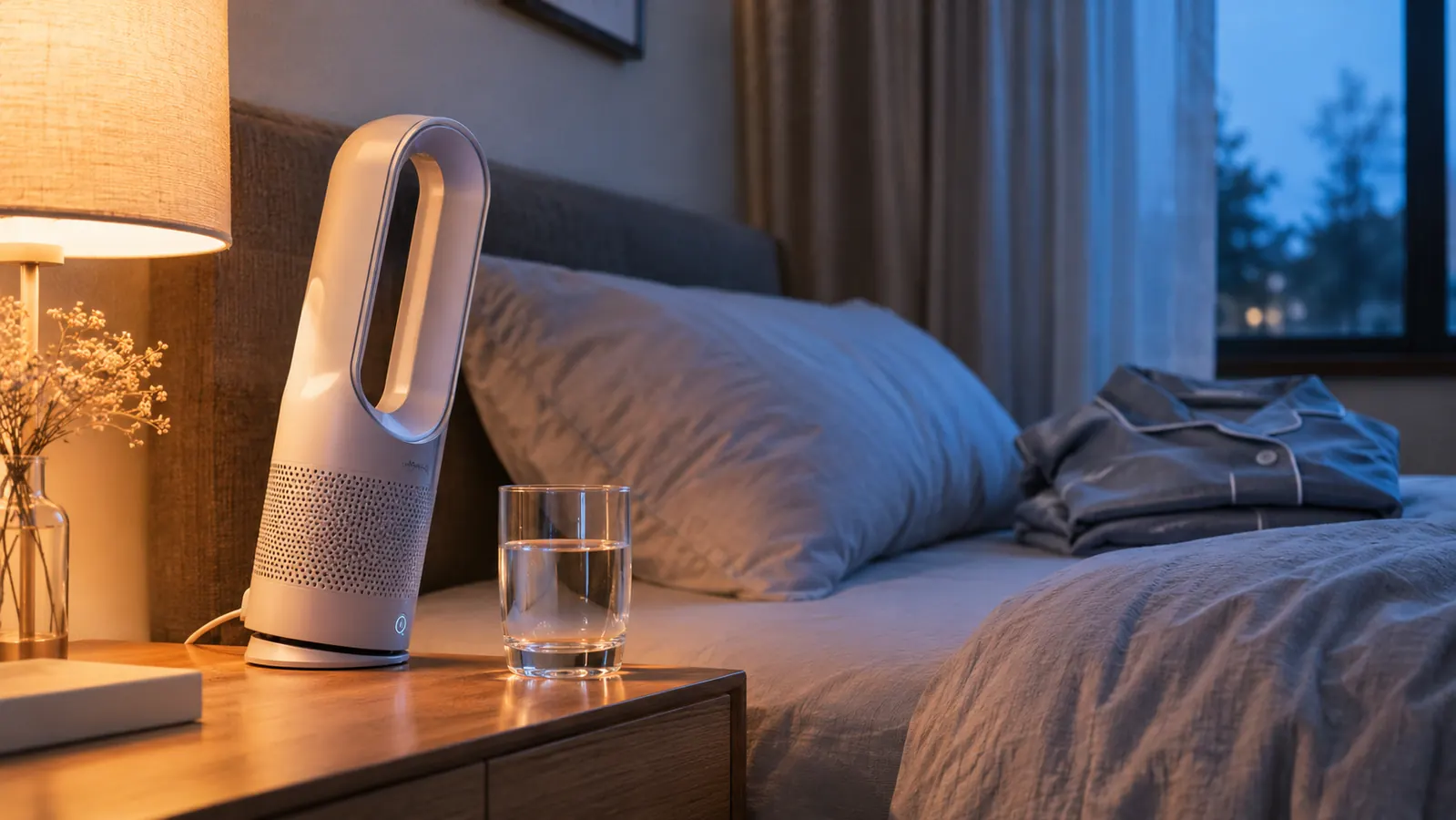
Buy two sets. That is the whole system. One is on you, one is clean and folded in the top drawer where you can reach it without turning on a light. When I wake up wet, I swap the top and sometimes the pants, and I am back under the covers before I am properly awake. Ten minutes of rummaging in a drawer would cost me the rest of the night.
Two NACHILA sets, washed cold and line dried, is enough for a week. They dry fast, which is the practical reason the rotation works. I wash mine with the sheets and hang them in the basement, and they are ready by the next evening.
Step 5: Set Up the Rest of the Bed Around the Pajamas
Pajamas are one layer of a system. If the mattress pad, the sheets and the blanket are all holding heat, the best pajamas on the market are working alone.
I keep a quilted cooling mattress pad on the bed year round, under the sheets. I bought it in April, five months back, and it has not come off since. It does not make the bed cold. It takes the heat-trapping edge off the spot under my back and hips at 2 a.m., and that is enough of a difference to notice.
The better change was separate covers. I have a double-sided cooling blanket on my side of the bed and Greg keeps his heavier comforter on his. We bought mine in late May and stopped negotiating over one shared blanket in the middle of the night, which did more for both of us than any single purchase. Mine is cool to the touch on one side and cotton on the other, and I flip it to the cotton side on cooler nights.
Cooling pillowcases were the first thing I bought, back in March, and the cheapest. I flip the pillow to the other side after a flash and that alone buys me a few more minutes. There is also a small bladeless fan on my nightstand pointed at my pillow, set low with the timer, and I reach for the remote during a flash. It does not cool the room. It moves air across my side only, so Greg is not sleeping in a draft.
Sheets matter less than I expected, honestly. I use plain cotton percale because it breathes, and I change it weekly. I did not buy special cooling sheets, and I would not spend on them before I had fixed the pad, the blanket and the pajamas first.
What Else Helps
Air movement does more than a colder house. Greg likes the thermostat at 70 and I have stopped fighting him about it. What I did instead was put the fan where it hits me and nobody else, and open the bedroom window in summer with the window air conditioner running. A cool room with still air feels worse to me than a warm room with a breeze on my face.
Keep water on the nightstand. Waking up sweaty makes you thirsty, and a sip at 3 a.m. is easier than a trip downstairs. A light layer you can kick off without waking up fully is worth more than a heavy comforter you have to fight.
None of this is a medical treatment. Pajamas, a pad, a fan and a blanket make the heat easier to sleep through. They do not stop hot flashes and they are not supposed to. If your night sweats are new, or heavy, or you are soaking through sheets several nights a week, take that to your doctor. I had that conversation and I am glad I did.
Two sets, rotated. I went from changing my sleep shirt most nights to once or twice a week, and the swap takes two minutes in the dark.
Buy Two. Keep One Within Reach.
The NACHILA bamboo viscose tank and capri set, in your usual size, washed cold and line dried. The rotation is what makes it work.
Amazon See the NACHILA Set on Amazon →