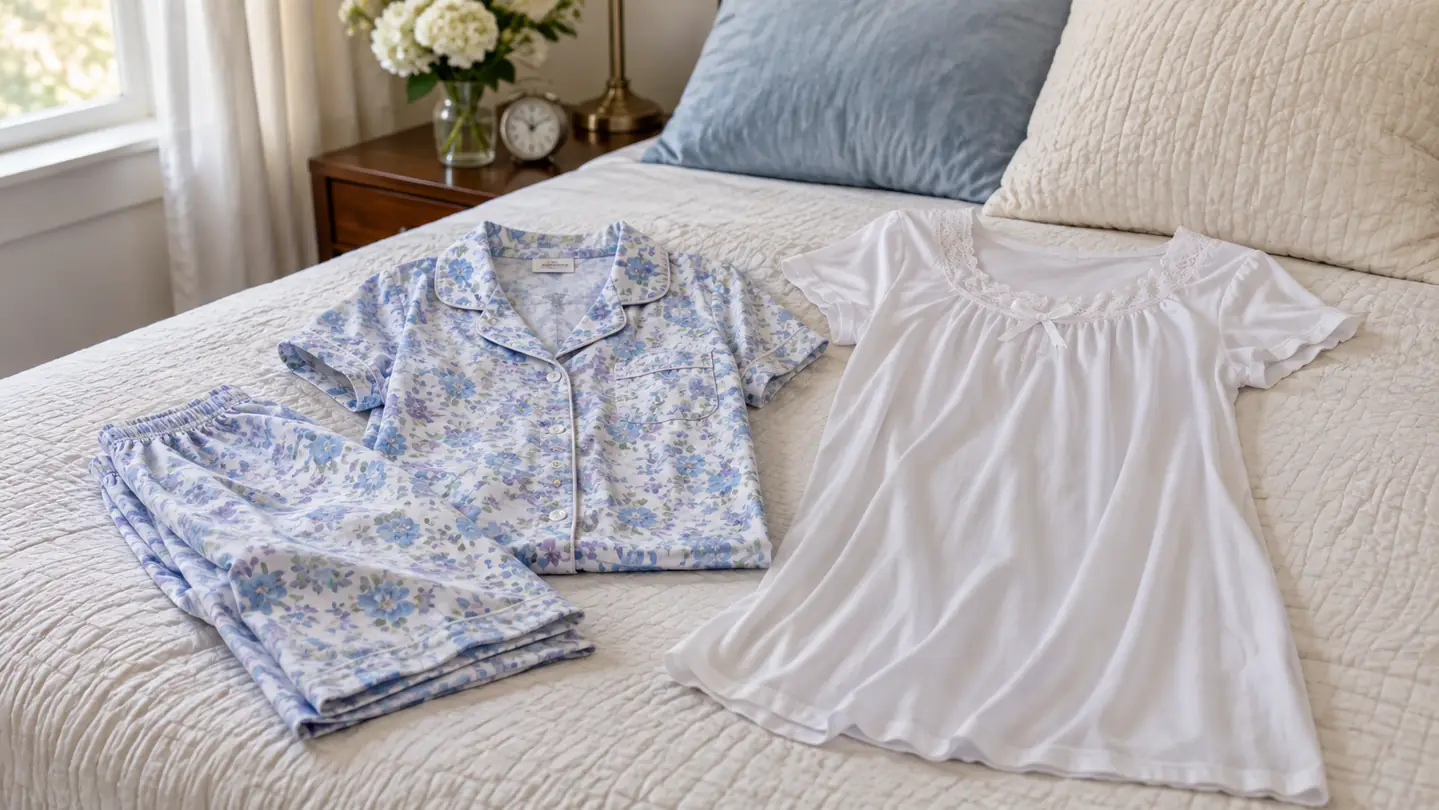
It is 3:12 in the morning and you are awake again, lying perfectly still so you do not wake anyone, with the back of your neck damp and the sheet under your hips warm in a way that has nothing to do with the thermostat. So you get up, peel off what you are wearing, find something dry, get back in. Forty minutes later you are awake again. I know that loop. It ran my nights for the better part of two years, and the single biggest thing that broke it was not a pill and not a fan. It was changing what I slept in.
Here is the short answer, in case you are reading this at 3 a.m. with one eye open. The NACHILA bamboo viscose pajamas, a short sleeve crew neck top with capri pants, handle the sweat itself better. The fabric feels cool when you first get in, it dries noticeably faster than cotton, and you can swap out just the top in the dark instead of the whole outfit. A loose cotton nightgown handles the heat better. More airflow, nothing sitting at your waist, and it goes straight in the dryer. Which one wins depends on whether your bad nights are mostly sweating or mostly overheating. Mine were both, which is why I ended up sleeping in the NACHILA set with the nightgown still hanging on the hook for the still, airless nights.
I am 55, I work day shift as a pharmacy technician, and I sleep upstairs in a west facing bedroom in a 1970s split-level in Kenosha, Wisconsin, next to a husband who runs warm and likes the thermostat at 70. My night sweats started at 50. The worst stretch was 52 to 54, when I was waking two to four times a night and changing my sleep shirt more often than I changed my socks. I have tried the nightgown, the sheets, the fan, the whole routine. What follows is how the two options actually compare, tested across six weeks of real nights and not a lab.
| NACHILA Bamboo Viscose Pajamas | Cotton Nightgown | |
|---|---|---|
| Fabric feel | Bamboo viscose, slick and cool the moment you get under the sheet, and it does not hold body heat the way cotton does | Cotton, soft and familiar, but it warms up within a few minutes of being against you |
| Drying after a sweat | Dries fast enough that a damp patch is often gone by the time I get back from the bathroom | Holds the damp longer, which is exactly why the 3 a.m. change became a habit |
| Airflow | Two pieces in a regular fit with a mid rise waist, so there is a waistband against skin all night | One loose layer with nothing at the waist and air moving freely underneath |
| Changing in the dark | Swap only the top and keep the capri pants on, so it is half the clothes and half the fumbling | One piece off, one piece on, done in a single motion if you are quick about it |
| Laundry | Cold wash and line dry, and the shape has held up fine over two months of rotation | Goes in the dryer with the towels and does not care |
| Cooler nights | Layers under a robe or a light blanket when the bedroom drops | A longer nightgown covers more on its own without adding another layer |
| Answering the door | Reads as a matching set, so a 7 a.m. delivery is not an event | It is a nightgown, and it looks like one |
| Cost to try | More than a drugstore nightgown, and you will probably want two sets in rotation | The cheaper way to find out whether fabric matters to you at all |
| Best for | Nights when you wake up damp and have to change something | Nights when you wake up hot and the room itself is the problem |
Where the NACHILA Pajamas Win
The first thing I noticed was not temperature. It was texture. Bamboo viscose has a cool, faintly slick hand against the skin when you first get in, and that is the whole reason the fabric has a following among women my age. My old nightgown was soft the way a well washed T-shirt is soft, which is genuinely pleasant for about four minutes and then it is just more fabric holding your own body heat against you. The NACHILA set does not do that. It sits there feeling neutral, which sounds like nothing until you have spent a year noticing the opposite.
Where it really separated itself was at the point of the problem, which is the damp patch. After a sweat, the fabric dried fast enough that I did not always have to get up at all. When I did get up, I could pull off the wet top, pull on a dry one, and leave the capri pants exactly where they were. That sounds like a small thing. At 3 a.m., with the light off and a husband asleep six inches away, doing half the changing is not small. It is the difference between being awake for six minutes and being awake for forty. I still have bad nights. I just do not have as many bad hours.
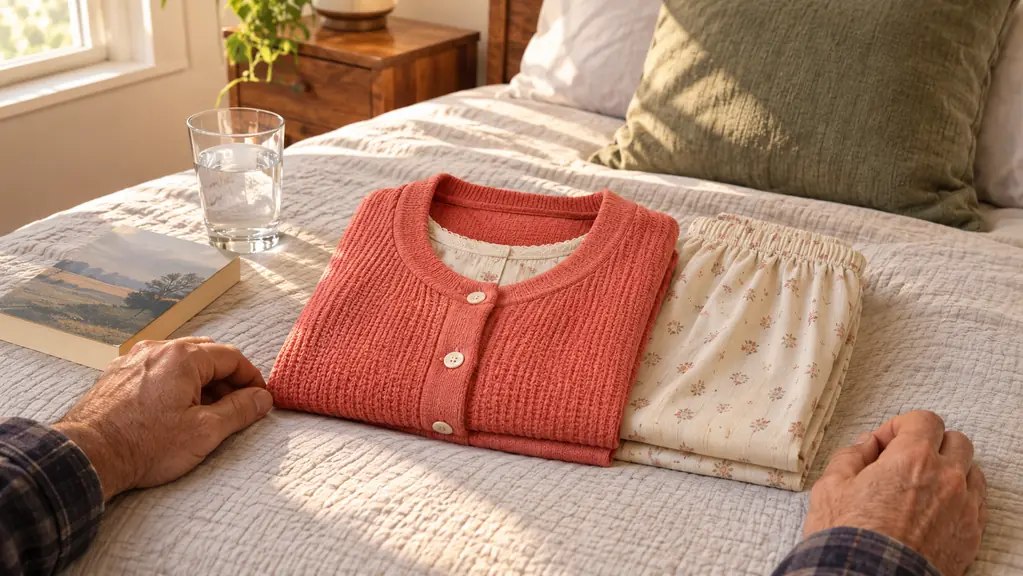
The construction is plain and does what the listing says, which I appreciate more the older I get. Short sleeve crew neck top, capri pants, regular fit, mid rise, and I ordered size Medium. No clever straps, nothing that needs to be adjusted at 3 a.m., no hardware to land on when you roll over. I bought two sets in June specifically so one is always clean, and I wash them cold and hang them on the line. Two months in, the hems and the seams are still where I left them.
The pajamas did not stop me sweating. They stopped a sweat from ending my night.
Where the Cotton Nightgown Wins
I am not going to pretend the set solves everything, because it does not, and the nightgown wins on the thing I underestimated for years: air. A loose cotton nightgown is one layer of moving air in a way that two fitted pieces simply are not. There is no waistband, nothing crossing your hips, nothing snug at the small of your back where you sweat first and worst. On a night when the bedroom itself is hot and the air conditioner is losing, the nightgown is the more comfortable garment, full stop. I wore one for a decade before I tried anything else and I understood why.
The nightgown also wins the laundry argument, and it is not close. Mine goes in with the towels and comes out of the dryer ready to wear. The NACHILA set gets cold washed and line dried, which means a certain amount of planning if you only own one. That is a real cost in the middle of a bad stretch when you are doing laundry at odd hours. If the whole idea of a special wash cycle makes you tired before you have even started, this comparison may already be over for you.
Two more places it earns its keep. Cooler nights, for one: a long nightgown covers more of you without a robe over the top, and I pull mine out in October when the forced air heat comes on and the bedroom goes from stuffy to cold by 4 a.m. Fit is the other. A nightgown is forgiving in a way a two piece set is not, and if your weight has shifted the way mine has since 50, forgiving counts for something. It is also the cheaper way to find out whether any of this matters to you.
The layer closest to your skin is the one that decides your night
Short sleeve crew neck top, capri pants, bamboo viscose. Two sets in rotation, cold wash, line dry. If you are going to change one thing about how you sleep, change the thing you are lying in.
Amazon Check Today's Price on Amazon →What Six Weeks of Switching Actually Looked Like
I did not run a formal test. I did what I always do, which is wear one thing for a week, then the other, then stop keeping track because I was tired. What I can tell you is what changed. Before, I was getting up to change my shirt on three or four nights out of seven. After six weeks in the set, that dropped to roughly one night a week, and on that night I usually only swapped the top. I was not waking up less often. I was going back to sleep faster, which after a certain age is the more useful number.
The other thing that changed was what my mornings looked like. When you are not doing a full outfit change at 3 a.m., you are not standing in front of a dresser in the dark deciding whether a shirt is dry enough to put back on. You are not leaving damp clothes in a pile on the floor to deal with at dawn. The whole production shrank. Greg noticed before I did. He said I had stopped getting in and out of bed like a person bailing out a boat.
There were also nights the set did nothing. Nights when the bedroom was still 78 degrees at midnight because the west facing window had been cooking all afternoon, nights when a flash rolled through me and I was soaked through anything, cotton or bamboo or paper. On those nights I wanted the loose nightgown and the fan and the window open and no fabric opinions whatsoever. That is not a knock on the pajamas. It is the honest shape of the problem. Some nights are about the garment, and some nights are about the room.
The Thing Neither One Fixes
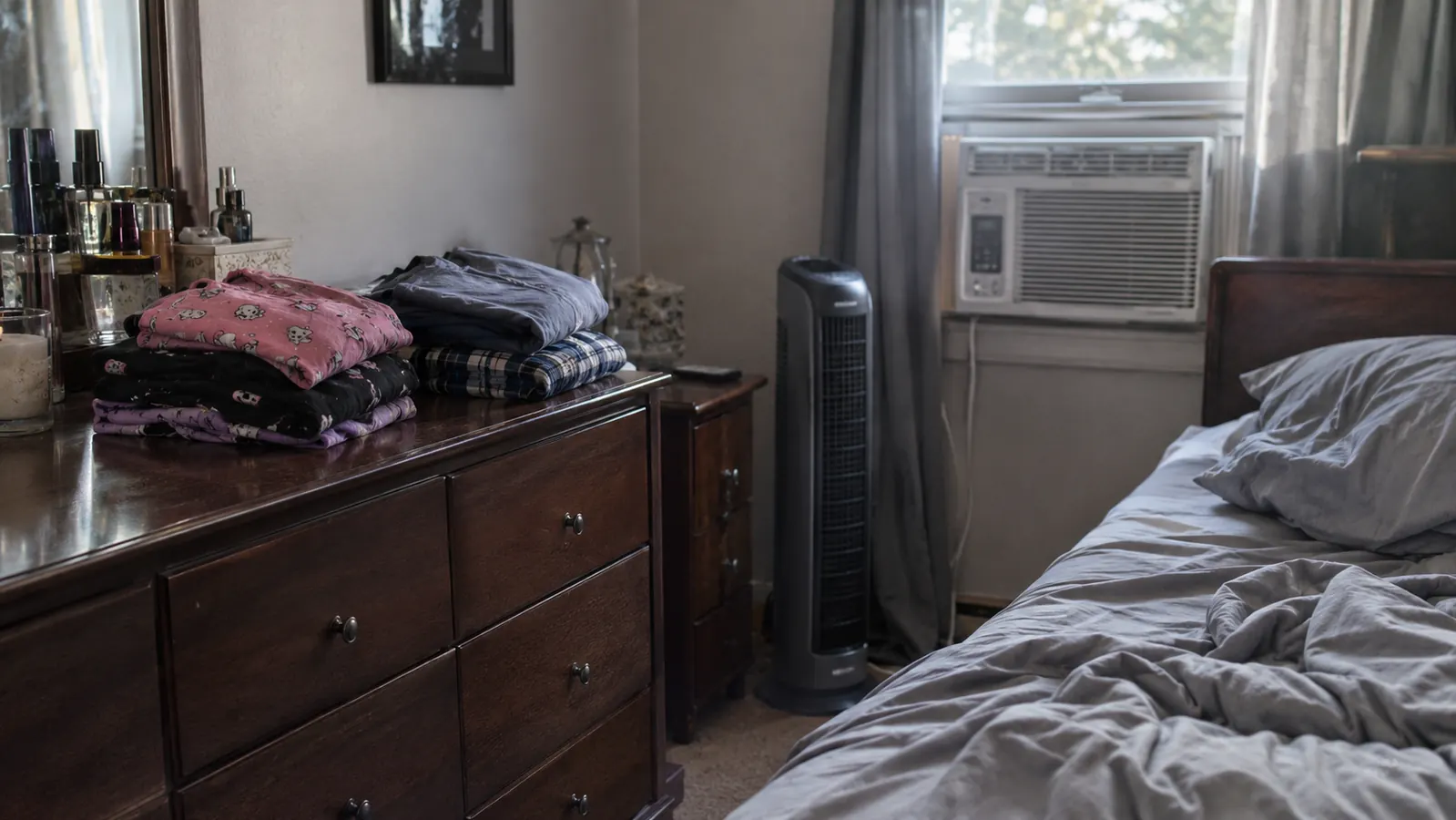
Because I do not want you spending money on the wrong fix, here is the rest of what is actually on my side of the bed. A cooling mattress pad under the sheets took the heat trapping edge off the hot spot under my back and hips, and it stays on year round. A cooling pillowcase is the cheapest thing I own and the one I flip to the dry side at 3 a.m. A small tower fan on the nightstand moves air across my side only, so Greg is not in a draft, and it does not cool the room. None of these is dramatic. Together they mean the bedroom is less of an enemy.
What none of them do, and what the NACHILA set does not do either, is stop a hot flash. No fabric does that. I talked to my doctor about my symptoms and I am not going to give anyone advice about hormones or prescriptions, because that is a conversation for your own doctor. What I can tell you is that these products make a bad night easier to get through, and a bad night that is easier to get through is one you go back to sleep in. That is a comfort question, not a medical one, and it is the only claim I am making.
Who Should Buy Which
Buy the NACHILA pajamas if your bad nights are damp nights. If you are waking up with a wet patch at the back of your neck or under your hips, if you have a pile of retired sleep shirts next to the bed, if the 3 a.m. change is a routine rather than an occasional event, this is the set that shortens the interruption. Buy two, size Medium or whatever matches your usual, and wash them cold. It is the layer touching your skin all night, and for me that layer was the whole problem.
Stay with the cotton nightgown, or buy a new one, if your trouble is temperature and not sweat. If your bedroom runs hot, if you hate anything fitted at the waist, if you want to throw your sleepwear in the dryer with everything else, or if you are in the cooler months and want one loose layer that covers more, the nightgown is the better tool and it costs less to find out. Plenty of women do just fine with one, and I kept mine on the hook for a reason. There is no prize for buying the more expensive option.
Start with the layer that is touching you all night
The nightgown stays on the hook for the still, airless nights. The NACHILA set is what gets me from 3 a.m. back to sleep. Two sets, cold wash, line dry, and a shorter interruption on the nights that go sideways.
Amazon See the NACHILA Pajamas on Amazon →