
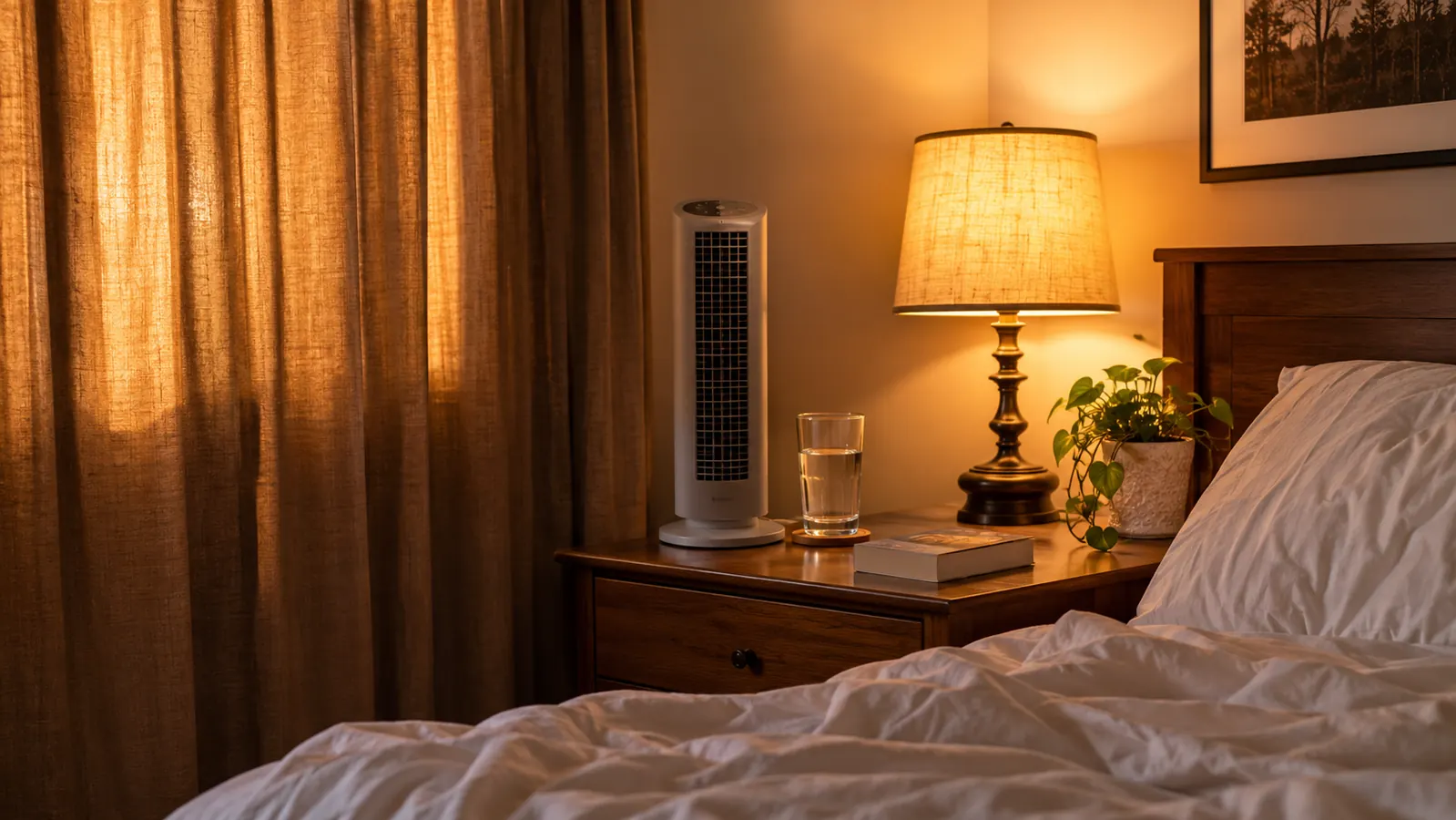
The upstairs bedroom in our 1970s split-level faces west, and that is the entire problem. From about two in the afternoon until the sun drops behind the neighbor's maple, that room takes direct sun on one window and one long wall. The heat soaks into the drywall and the carpet and the mattress, and it comes back out at you around nine at night, right when you are finally trying to settle.
That was the setup for my worst summers, ages 52 to 54, when I was waking two to four times a night and changing my sleep shirt in the dark. I am 55 now and I sleep through more often, but I still get hot flashes most nights. What has helped is not one big purchase. It is a Levoit Windi mini tower fan on my nightstand plus four habits I had to learn the hard way, and honestly the habits came first.
The Fan That Moves Air Across One Side of the Bed
The Levoit Windi is 13 inches tall and 3.4 pounds, with a carrying handle, five speeds, oscillation, a timer and a remote. It runs at 20 dB, so it does not wake the person next to you, and it is small enough to live on a nightstand between the water glass and the phone.
Amazon Check Today's Price on Amazon →Why the West Room Is Always the Last One to Cool Down
Sun on glass is not the same as warm air. Glass lets the light through, the light lands on the floor and the bed and the dresser, and all of that stuff holds it. By six in the evening the air outside may already be cooler than the air in that room, and the room will keep radiating at you for another three hours no matter what the thermostat says.
Which is why turning the thermostat down does not solve it. Greg likes the house at 70 and I have stopped arguing about it, because 70 in a room that has been baking since noon does not feel like 70. The air is the right temperature. The walls are not. That distinction is what the next five steps are built around.
Five Steps, in the Order That Actually Worked
Step 1: Get the Sun Out of the Room Before It Lands
The single biggest change in that bedroom cost nothing. I close the west-facing curtains by one in the afternoon, before the sun swings around, not after the room is already hot. Closing them at four is closing them too late. By then the heat is already in the carpet and the curtains are just holding it in.
If you can block the sun from outside the glass, do that instead. An exterior roller shade, a bamboo blind hung outside the frame, even a piece of shade cloth tacked up for July and August will beat any curtain you own, because the light never touches the window in the first place. I have not gotten around to an exterior shade. The heavy curtain pulled at one o'clock is the version I actually do every single day, and it is most of the benefit.
One more thing about curtains. A dark curtain hanging an inch from hot glass heats up and radiates into the room like a radiator panel. If you can leave a few inches of air between the fabric and the window, or use a liner with a reflective backing, the curtain does its job without becoming a new heat source. This is the least satisfying step and the one that changes the room the most.
Step 2: Flush the Stored Heat Out After Sunset
Around eight or nine at night, the outside air in Kenosha is usually cooler than my upstairs hallway. That is the window of opportunity. I open the west window and one window on the opposite side of the house and let the two of them argue. Cross ventilation does more in twenty minutes than the window air conditioner does in an hour, and it is free. This works in a split-level because the two windows are on different faces of the house, so there is actual pressure to move air rather than two holes in the same wall.
If there is no breeze at all, a box fan set in one window blowing out will pull cooler air in through the other. Point it out, not in. Blowing out pushes the hot air out of the top of the room; blowing in just stirs the same hot air around and makes you feel like you are doing something. I learned that from a neighbor after two summers of doing it backwards.
The window unit still runs in July and August. It is loud and it lives in the other wall, and it will take the room down to a point but not down to where I want to sleep. What it really does is take the edge off so that the fan has something to work with.
Step 3: Aim the Moving Air at Your Body, Not at the Room
This is where I had been getting it wrong for years. I kept buying bigger fans and pointing them at the middle of the room, trying to cool the whole space, and the whole space never got cool. What I actually needed was air moving across my skin, on my side of a queen bed, at about the speed of a slow walk.
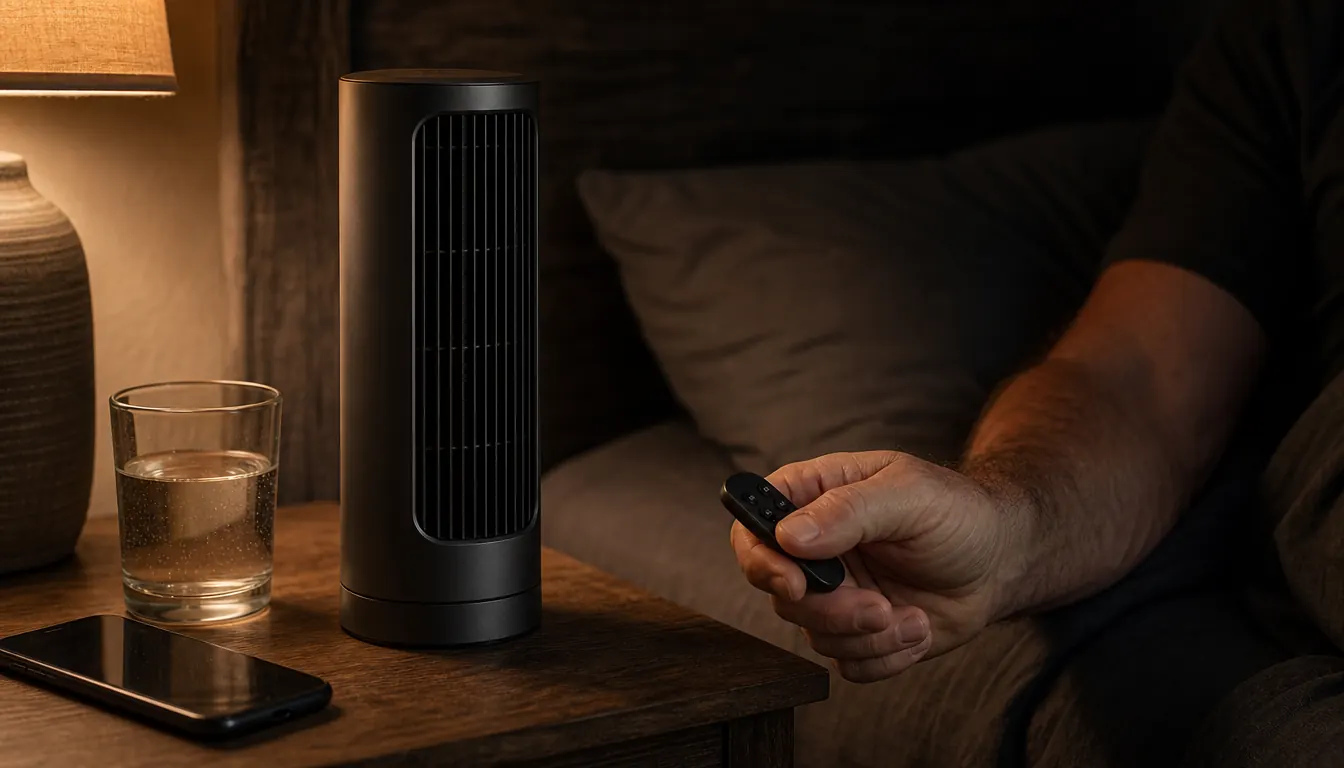
The Levoit Windi is a mini tower fan, 5 inches deep and 5 inches wide and 13 inches tall, which is small enough to sit on the nightstand between my water glass and my phone. It has a soft carrying handle and weighs 3.4 pounds, so I move it down to the kitchen counter on the worst afternoons and bring it back up at bedtime. It sits flat on the nightstand with the air roughly level with my pillow, angled down toward my shoulders.
I keep the oscillation off at night. Oscillating sends the air across Greg, who runs warm but hates a draft on his face, and then he wakes up and then I wake up. Straight at my pillow, no sweep. During the day I turn the oscillation on and let it move around the room while I am folding laundry. Five speeds is more than I need. I use the first one at night and the third one when I get in from work.
Step 4: Run It Low, Put It on a Timer, and Keep the Remote Within Reach
The Windi is rated at 20 dB across all five speeds, and I believe the low end of that. On speed one I can hear the clock ticking in the hallway. What I notice is not the sound, it is the absence of the little motor whine my old fan had, the one that got into my head at three in the morning and made me fixate on it instead of sleeping.
The other half of this step is the timer. I set it for a couple of hours when I go to bed. Long enough to carry me through the falling-asleep stretch, when I am warmest and most likely to be fighting the covers, and then it stops on its own. For a while I ran it all night and kept waking at four with cold shoulders and a dry throat, which is its own kind of ruined night.
The remote lives on the nightstand, which sounds lazy until you have had a flash at two in the morning and do not want to sit up, find the fan, and fumble for a button in the dark. One press from lying down is the whole point. It also means I do not wake Greg, who can sleep through the fan but not through me rummaging around for a remote I put somewhere else.
Power draw tops out at 7.5 watts with the DC motor, which is low enough that I stopped thinking about it. That is not why I bought it. It is why I leave it running on a hot afternoon without feeling silly about it.
Step 5: Cool the Body Itself, Because the Room Is Not Getting Colder
Air movement gets you through the falling-asleep part. The two in the morning part is a different problem, and for that I had to change what was on the bed. In April I put a MATBEBY cooling mattress pad under the sheets, over the existing mattress. It does not make the bed cold. What it does is take the damp hot spot under my back and hips down a notch, which is the difference between lying in it and sleeping through it. I wash it every two to three weeks on cold.
In late May I added the Elegear double-sided cooling blanket on my half of the bed only. Greg keeps his own heavier comforter. The cool-touch side feels cool when I first get in and cool again after a flash, and I flip it to the cotton side on the nights when the house is actually comfortable. The BEDELITE pillowcases came in March and were the cheapest thing I tried. I flip the pillow over after a flash and get a cool side for a few minutes, which turns out to be enough.
The NACHILA bamboo viscose pajamas came in June, two sets in medium, and they made a bigger difference than I expected. My old cotton nightgown would be soaked through and stay wet. These feel cool going on and dry faster after a sweat. I still change sometimes after a bad night. It is just far less often now.
Three summers of buying bigger fans taught me the same lesson: air moving across your skin at two in the morning does more than a bigger fan pointed at the ceiling.
What Else Helps
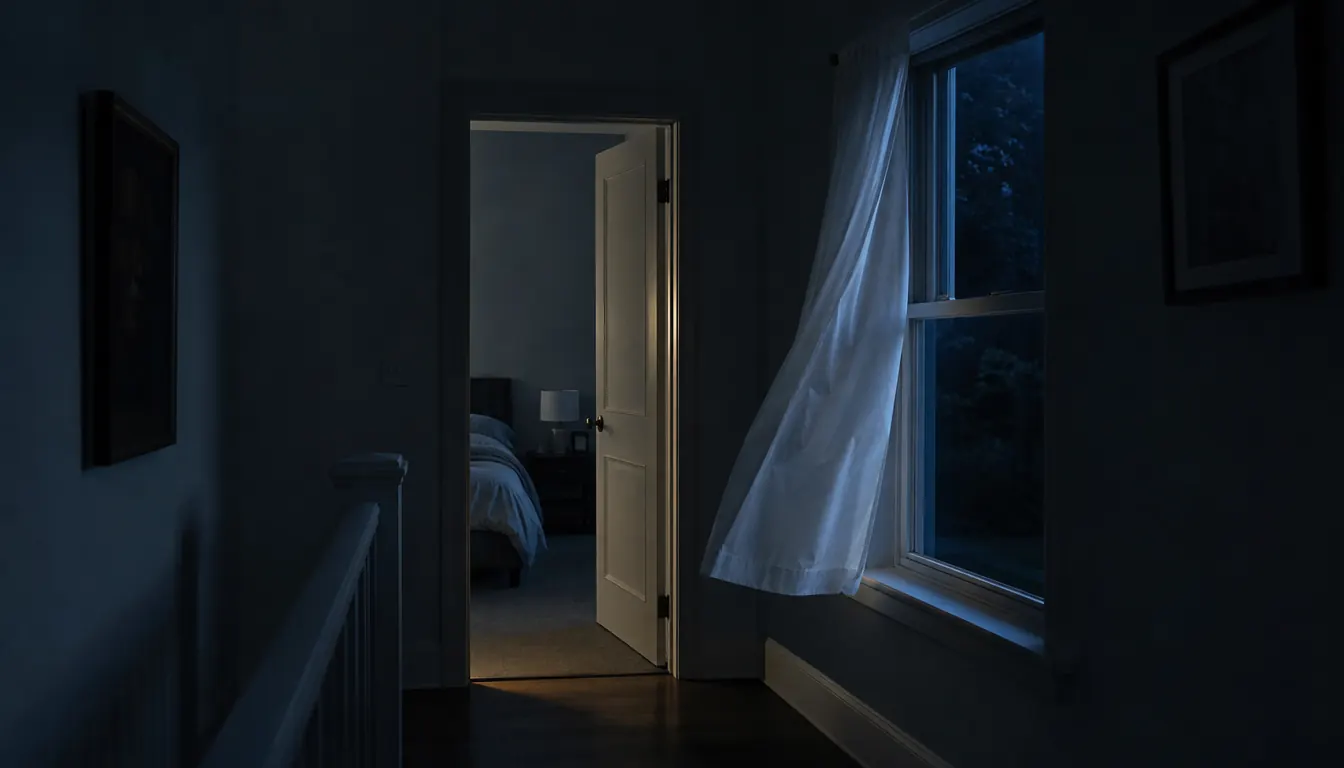
A few smaller things, in no particular order. I keep the bedroom door open a couple of inches overnight so the room is not sealed, and I close the register in that room in summer so the forced-air system is not quietly adding heat to a room that has plenty. I switched to cotton sheets in June and stopped using the polyester set entirely between May and September.
The ceiling fan runs on low, counterclockwise, in summer, just enough to keep the air from stratifying into a warm layer at the ceiling and a slightly less warm layer at the bed. On the worst nights I take a lukewarm shower before bed and get in while my skin is still cool. That buys me maybe forty minutes, and forty minutes at the front of the night is worth a lot.
The one thing I will not pretend about: none of this touches the hot flashes themselves. A fan and a cooling pad and a set of pajamas make the heat easier to sleep through. They do not reduce how often it happens, and anyone who tells you otherwise is selling something. If you are waking four times a night, sweating through sheets, and it has been going on for months, talk to your doctor. I did, and it was the right call, and it is a longer conversation than a bedroom fan can have with you.
Start With the Small Fan, Then Fix the Room Around It
13 inches tall, 3.4 pounds, five speeds, oscillation, a timer and a remote, rated at 20 dB on every speed. It will not cool your bedroom. It will move air across the side of the bed where you are lying awake.
Amazon Check Today's Price on Amazon →