

I am 55, I work the day shift as a hospital pharmacy technician in Kenosha, Wisconsin, and I have been sleeping in the same upstairs bedroom for more than twenty years. It faces west, so the afternoon sun bakes it, and in winter the forced-air heat pushes warm air at the ceiling. My night sweats started at 50. The worst stretch was ages 52 to 54, when I woke two to four times a night and changed my sleep shirt at least once. Greg, my husband, runs warm and snores, and he likes the thermostat at 70. I am not going to pretend a bedding product fixes any of that. What I can tell you is that the MATBEBY cooling mattress pad, which I bought in April and have used for five months, is the piece that made the biggest difference to the hot, damp spot under my back and hips at 2 a.m. This is how I set it up so it actually helps.
The pad is a queen size, 60 by 80 inches, quilted polyester, with a deep pocket that fits mattresses up to 21 inches. It is soft, breathable, machine washable, and not water resistant. It is a pad, not a thick topper, so it does not change how firm the mattress feels. It also does not make the bed cold. If you are looking for a slab that stays chilly all night, this is not that. What it does is take the heat-trapping edge off the surface under you, so you are less likely to wake up stuck to your own sheet. The setup matters as much as the pad. I still get hot flashes most nights, and this is the layer that gives me a way back to sleep instead of a reason to get up.
Put the pad where the heat collects, not on top of it
The MATBEBY queen pad goes directly over the mattress and under your fitted sheet. Quilted polyester, breathable, deep pocket to 21 inches, machine washable. It is the layer I leave on year round.
Amazon See the MATBEBY Pad on Amazon →Step 1: Put the pad directly on the mattress, under your fitted sheet
The first night I tried it, I put it over the fitted sheet because I wanted to feel the quilted surface. That was wrong for us. It slid, the sheet underneath bunched, and the pad did not sit flat. The right way is pad first, directly over the mattress, then the fitted sheet over it. The pad stays put, the sheet stays smooth, and the breathable layer is close enough to your body to do its job.
This matters because you are not trying to build a wall between you and the mattress. You are trying to give the heat somewhere to go. A pad buried under three layers cannot help with the damp spot under your back. A pad directly on the mattress, with one sheet over it, can. I also leave the mattress protector off in summer. The MATBEBY pad is not water resistant, so it is not a spill protector, but that also means it is not a plastic sheet trapping heat under me.
If your mattress has a pillow top or a deep profile, check the fit before you make the bed. Our queen is a standard depth, and the pocket had room. The listing says it fits up to 21 inches, and mine does. Tuck any excess under the mattress rather than letting it bunch at the foot. A pad that is stretched tight and flat is doing its job. A pad that is loose is just another layer to fight with at 3 a.m.
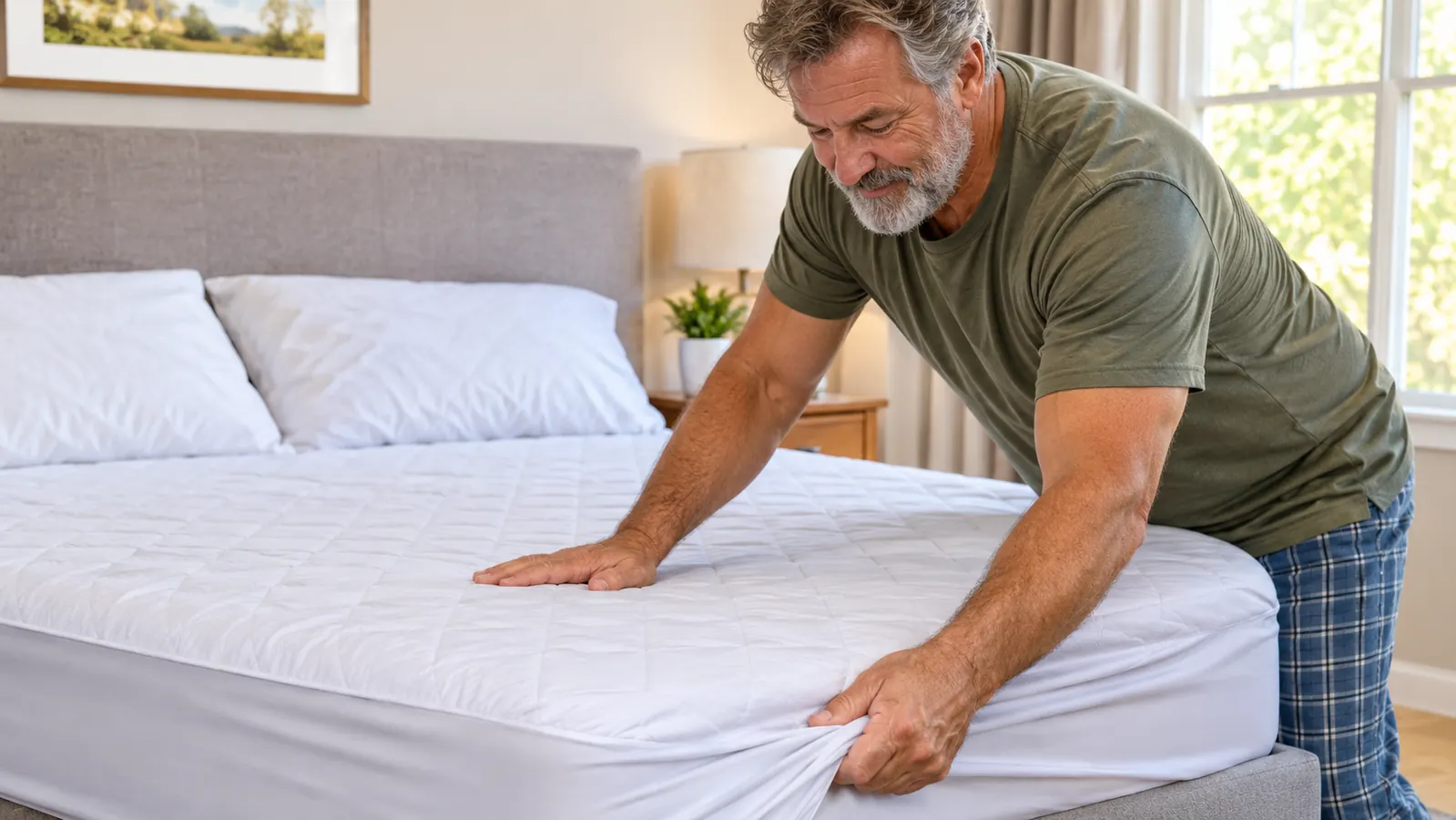
Step 2: Pull the deep pocket all the way down and smooth the quilting flat
A cooling pad only works if it is flat. If the quilting is bunched under your hips, you have created a ridge, and a ridge is a hot spot. I get on one side of the bed, pull the pocket down over the corner, then walk around and do the same on the other side. Then I run both hands from the head of the bed to the foot, pressing the quilting flat.
The MATBEBY pad has a pull on closure, which means there is no zipper to fight. You stretch the skirt over the corners and pull it down. I still take an extra minute to make sure the corners are seated all the way. If one corner pops up in the night, the pad shifts, and you wake up on a wrinkle. A wrinkle is not dangerous, but it is annoying when you are already hot and trying to fall back asleep.
Once the pad is flat, put the fitted sheet on and smooth it the same way. I do not use a mattress protector over the pad in summer. In winter I sometimes put a thin cotton blanket between the pad and the sheet on Greg's side because he likes a little more warmth. On my side, the pad stays directly under the sheet year round. That is the whole point: one layer that does not move, so I do not have to remake the bed after every flash.
Step 3: Dress the bed in layers you can peel off at 2 a.m.
The pad is one layer. The rest of the bed is the other half of the setup. I used to sleep under a heavy comforter because that is what I thought a bed was supposed to look like. Then I would wake up sweaty, throw the comforter off, freeze ten minutes later, and pull it back on. That cycle is worse than the night sweat itself.
Now I use a light sheet and the Elegear double-sided cooling blanket on my side. Greg keeps his own heavier comforter on his half. The blanket has a cool-touch side and a cotton side. I flip it to cotton on cooler nights. It feels cool when I first get in and after a flash, but it is not a cooling device and it does not stay cold all night. That is fine. It gives me something to pull up that does not immediately trap heat.
The point is not to buy five products. The point is to make it easy to adjust without getting out of bed. A pad under you, a light layer over you, and a fan within reach will do more than a mountain of heavy bedding. If you sleep with a partner, split the bed. Greg and I have separate top layers now, and neither of us is yanking the covers off the other. That alone cut down on the middle-of-the-night wrestling matches.
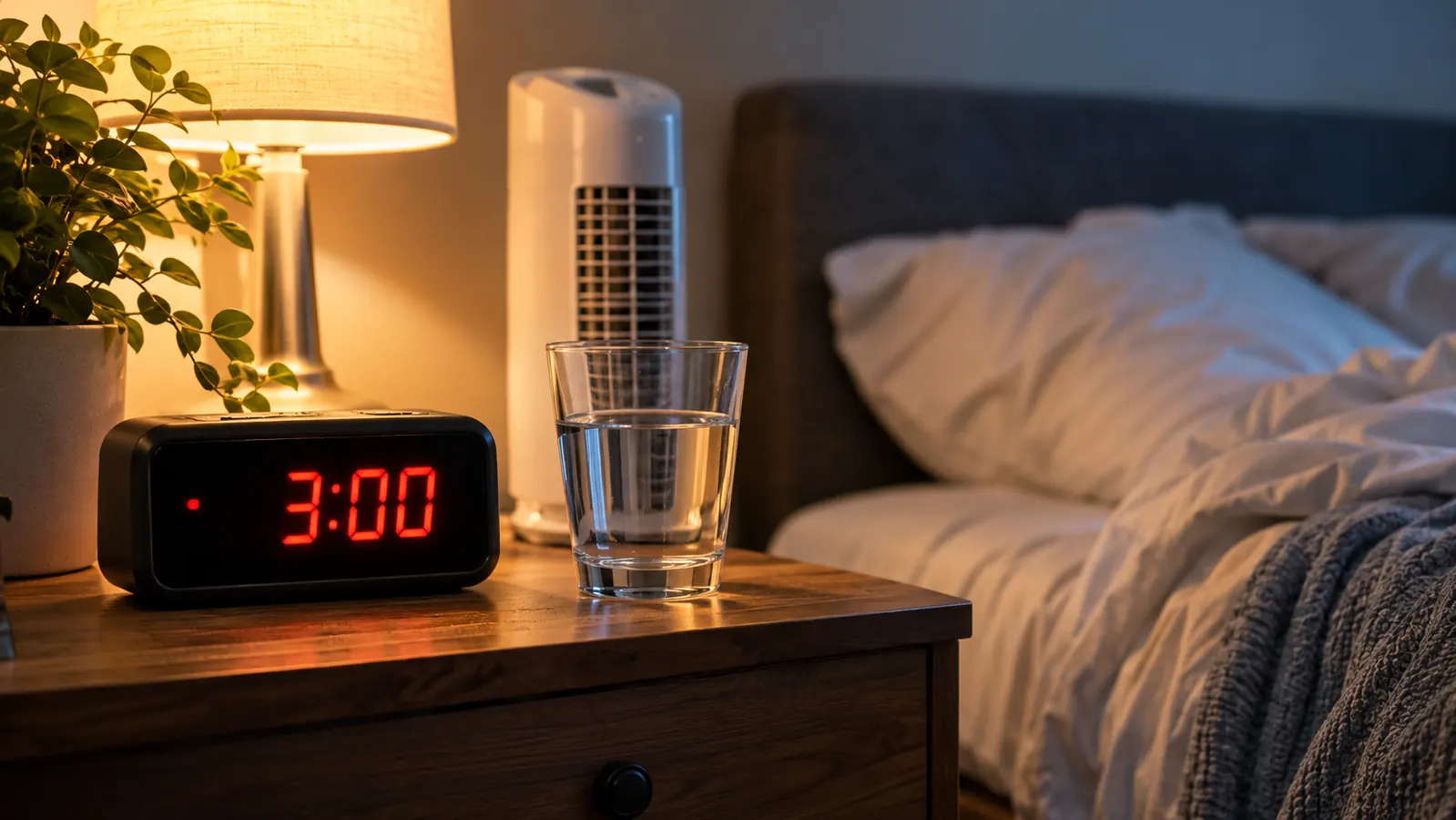
Step 4: Put airflow where your upper body is, not across the whole room
I bought the Levoit Windi mini tower fan in July. It is bladeless, about 13 inches tall, with 5 speeds, oscillation, a timer and a remote. It sits on my nightstand pointed at my pillow. I set it low with the timer when I go to bed, and I grab the remote during a flash. It does not replace the window air conditioner and it does not cool the whole room. It moves air across my side only, so Greg is not in a draft.
The fan and the pad work together. The pad takes the heat out of the surface under me. The fan keeps the air moving over my face and chest, which is where I feel a flash first. I do not aim it at my feet. I do not put it on high all night. A steady low movement is enough to keep the air from feeling stale. If you do not have a fan, a ceiling fan on low or a window cracked two inches can help, but the small fan is the thing I reach for.
One caution: do not point a fan directly at your head if you are prone to sinus problems or you wake up with a dry throat. I aim mine at the pillow from the side, not at my face. And I keep the timer on so it shuts off after a couple of hours. By then I am usually past the worst of it. If I wake up again, the remote is right there and I do not have to get up to find it.
Step 5: Wash it on cold every two to three weeks and dry it low or line dry
Night sweats mean the pad gets more than ordinary use. I wash mine every two to three weeks on cold with a gentle detergent. The care instructions say machine wash, easy care, and I have not had a problem. I do not use bleach or fabric softener. I do not dry it on high heat. High heat is hard on polyester and it can make the quilting bunch.
I usually line dry the MATBEBY pad outside if the weather is decent, or tumble it on the lowest heat for a short cycle and then drape it over the stair rail to finish. It dries faster than I expected for a quilted pad. If you have a second pad, rotate them. I do not, so I wash it on a morning when I can put the bed back together before lunch. That sounds like a small thing, but it is the difference between washing it and putting it off.
This is also the time to check the seams and the corners. After five months and a handful of washes, mine still fits the mattress and the quilting has stayed put. The listing includes a one year quality assurance, and I understand why they mention care. A pad that is washed wrong will not lie flat, and a pad that does not lie flat is just a lumpy sheet. If the corners start to feel loose, tug the skirt back down and smooth the top before you make the bed again.
What Else Helps
The pad is the base layer, but it is not the whole bedroom. I also use BEDELITE cooling pillowcases, a set of two queen cases made from viscose from bamboo with envelope closures. I bought them in March, before the pad, because they were the first thing I tried. I use one and Greg uses the other. After a hot flash I flip the pillow to the other side. That small move buys me a few minutes of cooler contact, and sometimes a few minutes is all I need to get back to sleep.
The NACHILA bamboo viscose pajamas helped more than I expected. I bought two sets in June, size Medium, short-sleeve crew neck top with capri pants. They feel cool and they dry faster than my old cotton nightgown after a sweat. I still sometimes change after a bad night, but far less often. I wash them on cold and line dry them. Having two sets means one can be in the wash and I am not digging through a drawer at midnight.
The room itself matters. Our bedroom faces west, so I close the blinds in the afternoon before the sun hits. I keep the thermostat where Greg likes it, 70, but I use the window air conditioner in summer and a fan on my side. I do not eat a big meal late. I do not drink alcohol close to bed. Those are not cures, and I am not going to tell you they stop hot flashes. They just remove a few extra degrees from the equation. If your night sweats are severe, talk to your doctor. A mattress pad is a comfort tool, not a treatment.
I also keep a spare sleep shirt on the hook behind the bedroom door and a glass of water on the nightstand. That is not a product recommendation. It is just what makes a 3 a.m. wakeup less of a production. The less I have to do when I am hot and half asleep, the faster I get back into bed. The MATBEBY pad is the layer that keeps that wakeup from turning into a full sheet change.
Five months in, the pad does not make the bed cold. It takes the hot, damp spot under my back and hips down a notch, and that is enough to get me back to sleep.
If you are tired of changing your sleep shirt at 2 a.m., start with the layer under you
The MATBEBY queen cooling mattress pad is 60 by 80 inches, quilted polyester, breathable, with a deep pocket that fits mattresses up to 21 inches. It is machine washable and soft. It will not make the bed cold, but it can take the trapped heat off your side.
Amazon See the MATBEBY Pad on Amazon →